



LISTENING AND TEXT
5–7, 10: Adapted from “Vanishing Venice,” by Cathy Newman: National Geographic Magazine, August 2009
14–16: Adapted from “The Singapore Solution,” by Mark Jacobson: National Geographic Magazine, January 2010
19: Adapted from “Urban Fishing Catches on in Rebounding Rivers” by James Owen: National Geographic Daily News, May 17, 2010
25: Adapted from “Forests of the Tide,” by Kennedy Warne: National Geographic Magazine, February 2007
26–27: Adapted from “Last One,” by Verlyn Klinkenborg: National Geographic Magazine, January 2009
34: Adapted from “Freshwater Hero,” National Geographic Web site
35: Adapted from “Wolf Wars” by Douglas Chadwick: National Geographic Magazine, March 2010
36–37: Adapted from “Hunters: For the Love of the Land,” by Robert M. Poole: National Geographic Magazine, November 2007
46–47: Adapted from “The Enigma of Beauty,” by Cathy Newman, National Geographic Magazine, January 2000
46–47: Adapted from “New ‘Golden’ Ratios for Facial Beauty,” by Pamela Pallett et al., National Institute of Health, January 25, 2010
56–57: Adapted from “Dreamweavers,” by Cathy Newman: National Geographic Web site, January 1, 2003
56–57: Adapted from “Artificial Spider Silk Could Be Used for Armor, More,” by Brian Handwerk: National Geographic Daily News, January 14, 2005
64: Adapted from “Is Another Deepwater Disaster Inevitable?,” by Joel K. Bourne, Jr.: National Geographic Magazine, October 2010
66–67: Adapted from “The Long Shadow of Chernobyl,” by Richard Stone: National Geographic Magazine, April 2006
84–87: Adapted from “Human Journey” by James Shreeve: National Geographic Magazine, March 2006
84–87: Adapted from “From Africa to Astoria by Way of Everywhere,” by James Shreeve: National Geographic Web site, August 17, 2009
96–97: Adapted from “Heartbreak on the Serengeti” by Robert M. Poole: National Geographic Magazine, February 2006
104: Adapted from “The Hadza,” by Michael Finkel: National Geographic Magazine, December 2009
106–107, 111: Adapted from “Bhutan’s Enlightened Experiment” by Brook Larmer: National Geographic Magazine, March 2008
110: Adapted from “Spread of the Amish” by National Geographic Staff: National Geographic Blog Central, July 8, 2009
114: Adapted from “Disappearing Languages: Enduring Voices Project,” National Geographic Web site, January 2011
115–117: Adapted from “Native Lands,” by Charles Bowden: National Geographic Magazine, August 2010
118: Adapted from “‘Spectacular’ Three-Cat Monolith Unearthed in Mexico,” by Ker Than: National Geographic Daily News, August 1, 2011
118: Adapted from “Machu Picchu’s Mysteries Continue to Lure Explorers,” by Kelly Hearn and Jason Golomb: National Geographic Web site
124, 126–127: Adapted from “Living it Up, Paying it Down,” by Mary McPeak: National Geographic Magazine, February 2005
144, 146–147: Adapted from “The Pollution Within,” by David Ewing Duncan: National Geographic Magazine, October 2006
156–157: Adapted from “Yosemite Climbing,” by Mark Jenkins: National Geographic Magazine, May 2011
165–167: Adapted from “Minds of Their Own,” by Virginia Morrell: National Geographic Magazine, March 2008
175: Adapted from “Young Chimp Outscores College Students in Memory Test,” by Malcolm Ritter: National Geographic News, December 3, 2007
176–177: Adapted from “Remember This” by Joshua Foer: National Geographic Magazine, November 2007
184, 186–187, 189: Adapted from “Food: How Altered?,” by Jennifer Ackerman: National Geographic Magazine, May 2002
184: Adapted from “Food Ark,” by Charles Siebert: National Geographic Magazine, July 2011
194–197: Adapted from “The Global Food Crisis: The End of Plenty,” by Joel K. Bourne, Jr.: National Geographic Magazine, June 2009
PHOTOS
1: Richard Levine/Alamy
3: Jodi Cobb/National Geographic Image Collection
3: Fritz Hoffmann/National Geographic Image Collection
4: Atelier Tekuto
4: Andy Z/Used under license from Shutterstock.com
4: Frances Roberts/Alamy
5: Jo Chambers/Shutterstock.com
6: Jodi Cobb/National Geographic Image Collection
9: Caitlin Mirra/Shutterstock.com
11: Mike Theiss/National Geographic Image Collection
12: Frans Lemmens/SuperStock
13: Matt Fletcher/Lonely Planet Images/Alamy
13: Rich Carey/Shutterstock.com
14: Caro/Alamy
14: Toshifumi Kitamura/AFP/Getty Images
16: Joseph Calev/Shutterstock.com
19: James Owen
21: Brian J. Skerry/National Geographic Image Collection
22: Pi-Lens/Shutterstock.com
22: Jason Lugo/iStockphoto.com
22–23: Beverly Joubert/National Geographic Image Collection
24: All Canada Photos/SuperStock
25: Tim Laman/National Geographic Image Collection
26: John A. Anderson/Shutterstock.com
26: Joel Sartore/National Geographic Image Collection
28: Gary Meszaros/Photo Researchers, Inc.
29: Alexandr Pakhnushchy/Shutterstock.com
29: CraigRJD/iStockphoto.com
32: BsChan/Shutterstock.com
33: Nuil/FLPA/Alamy
34: Joel Sartore/National Geographic Image Collection
35: Len Tillim/iStockphoto.com
36: Bruno Barbey, Magnum/National Geographic Image Collection
40: Perrush/Shutterstock.com
41: George Steinmetz/National Geographic Image Collection
42: GoGo Images/Jupiter Images
42: Greg Dale/National Geographic Image Collection
42–43: Mike Theiss/National Geographic Image Collection
44: Justin Guariglia/National Geographic Image Collection
45: esolla/iStockphoto
46: Reprinted from Vision Research, Vol 50, No 2, 25th January 2010, Pallett et al., “New ‘Golden’ ratios for facial beauty” with permission from Elsevier
47: Peter Zagar/National Geographic Image Collection
49: Demid Borodin/Shutterstock
50: Todd Gipstein/National Geographic Image Collection
52: Sarah Leen/National Geographic Image Collection
52: Joe McNally/National Geographic Image Collection
53: photobywayne/Alamy
53: Sarah Leen/National Geographic Image Collection
54: John Macdougall/AFP/Getty Images
55: Cary Wolinsky/National Geographic Image Collection
56: Designer: Alex Soza/Photographer: Peter Svendsen
56: Tom Vickers/Splash/Newscom
56: Yoshikazu Tsuno/AFP/Getty Images
58: Natil Glado/Shutterstock.com
60: A.J. Wilhelm/National Geographic Image Collection
60: Mike Theiss/National Geographic Image Collection
61: Hervé Lenain/Hemis/Corbis
62–63: Joel Sartore/National Geographic Image Collection
63: James M. Phelps, Jr./Shutterstock.com
63: Michael Utech/Vetta Collection/iStockphoto
64: Tyrone Turner/National Geographic Image Collection
65: Brendan Howard/Shutterstock.com
68: Gerd Ludwig/National Geographic Image Collection
69: huyangshu/Shutterstock.com
69: nito/Shutterstock.com
69: oorka, 2009/Used under license from Shutterstock.com
72: Tobias Machhaus/Shutterstock.com
73: George Steinmetz/National Geographic Image Collection
74: Samuel Acosta/Shutterstock.com
74: Image copyright Belinda Pretorius, 2010 Used under license from Shutterstock.com
75: Annie Griffiths/National Geographic Image Collection
79: Angela Hampton/Angela Hampton Picture Library/Alamy
80: Sarah Leen/National Geographic Image Collection
81: Norbert Rosing/National Geographic Image Collection
82: Bill Bachmann/Alamy
83: Joe McNally/National Geographic Image Collection
84: Jim Richardson/National Geographic Image Collection
86: Anthony Perrotta
86: Piero Gherardi
86: Valerie Chazottes Louvat
86: Lisa Hopgood, 89: image copyright Paul Bankson/used under license from www.shutterstock.com
89: mhrmn/Shutterstock.com
92: Beverly Joubert/National Geographic Image Collection
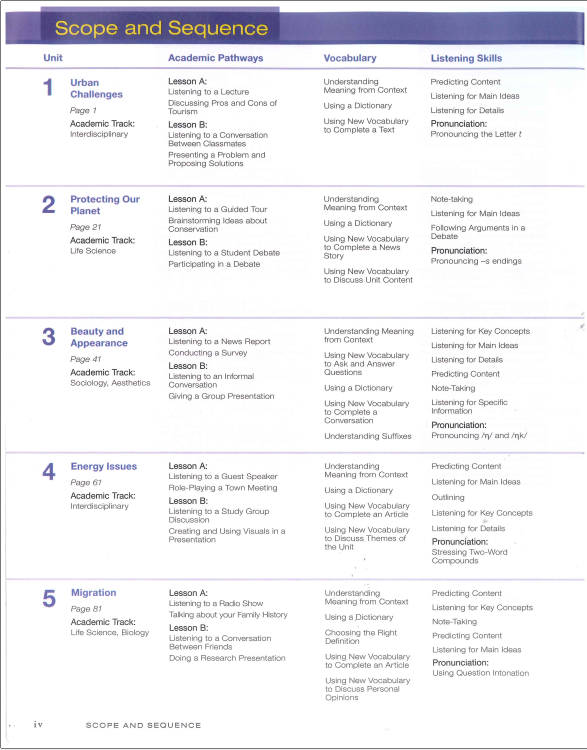
A – Meaning from Context
Read and listen to the information about the ways that some cities are meeting new challenges. Notice the words in blue. These are words you will hear and use in Lesson A.
Finding affordable land for housing is a challenge in many of the world’s largest cities. Some residents of Tokyo, Japan, have found a solution to this problem. They are building homes on pieces of land as small as 344 square feet (32 square meters). These “micro-homes” allow people to live close to central Tokyo and cost much less than other homes in the city. Many micro-homes have several floors and big windows that maximize sunlight.
Many cities have problems with air pollution and smog. What can big cities do to regulate the amount of air pollution and smog generated by cars and factories? An Italian company has come up with an innovative tool to reduce pollution: smog-eating cement. The cement contains a substance that converts pollution into harmless chemicals. The harmless chemicals wash off roadways when it rains. Smog-eating materials are also being used in roof tiles in Los Angeles, California, the smoggiest city in the United States.
Cities must find creative ways to build public parks, gardens, and outdoor areas when space is limited. In New York City, the High Line was an unattractive black steel structure that once supported railroad tracks. Today, the High Line has been restored as an elevated urban park. The park was financed by donations, and now it is one of the most inviting public spaces in the city. Visitors can walk through the gardens, relax on the sundeck, and attend public art exhibits and special events.
Smog is a combination of smoke and fog that can damage the health of humans, plants, and animals.
B – Match each sentence beginning to its ending
- The residents of a house or area are ___
- To finance something means ___
- If you maximize something, ___
- A challenge is ___
- An innovation is ___
- If you restore an old painting, ___
- To regulate something means ___
- When you generate something, ___
- A structure is ___
- To convert one thing into another means ___
Endings:
a. you repair and clean it.
b. to change it so that it can be used for another purpose.
c. the people who live there.
d. you produce it, or cause it to be produced.
e. something new and creative.
f. you increase it as much as possible.
g. something that has been built.
h. a difficult job that requires effort.
i. to control the way it is done.
j. to pay for it.
Tải FREE sách Pathways 4 – Listening, Speaking And Critical Thinking PDF
TRANG 1 (viii)
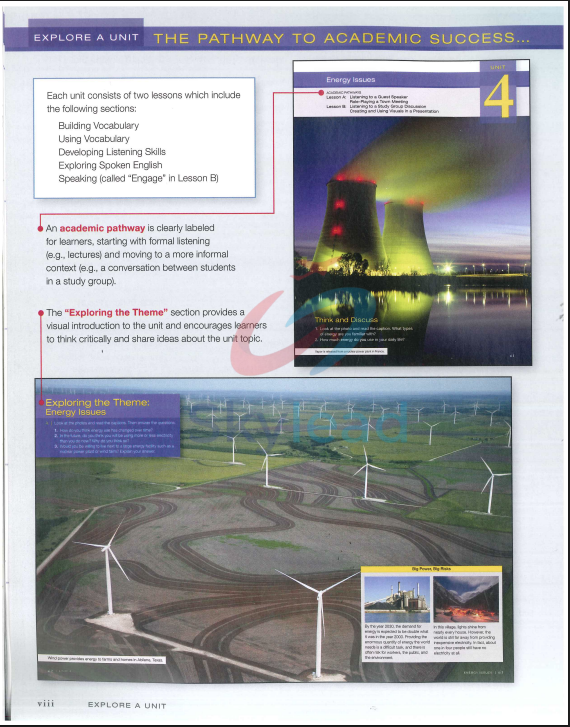
Thanh tiêu đề: EXPLORE A UNIT | THE PATHWAY TO ACADEMIC SUCCESS…
Khung văn bản bên trái:
Each unit consists of two lessons which include the following sections:
- Building Vocabulary
- Using Vocabulary
- Developing Listening Skills
- Exploring Spoken English
- Speaking (called “Engage” in Lesson B)
Các điểm ghi chú (Dấu chấm đỏ):
- An academic pathway is clearly labeled for learners, starting with formal listening (e.g., lectures) and moving to a more informal context (e.g., a conversation between students in a study group).
- The “Exploring the Theme” section provides a visual introduction to the unit and encourages learners to think critically and share ideas about the unit topic.
Nội dung trong các trang mẫu (Unit 4 – Energy Issues):
- Energy Issues | UNIT 4
- ACADEMIC PATHWAYS:
- Lesson A: Listening to a Guest Speaker; Role-Playing a Town Meeting
- Lesson B: Listening to a Study Group Discussion; Creating and Using Visuals in a Presentation
- Think and Discuss:
- Look at the photo and read the caption. What types of energy are you familiar with?
- How much energy do you use in your daily life?
- Chú thích ảnh: Vapor is released from a nuclear power plant in France.
Nội dung phần Exploring the Theme: Energy Issues:
- A. Look at the photos and read the captions. Then answer the questions.
- How do you think energy use has changed over time?
- In the future, do you think you will be using more or less electricity than you do now? Why do you think so?
- Would you be willing to live next to a large energy facility such as a nuclear power plant or wind farm? Explain your answer.
- Chú thích ảnh chính: Wind power provides energy to farms and homes in Abilene, Texas.
- Khung “Big Power, Big Risks”:
- By the year 2030, the demand for energy is expected to be double what it was in the year 2000. Providing the enormous quantity of energy the world needs is a difficult task, and there is often risk for workers, the public, and the environment.
- In this village, lights shine from nearly every house. However, the world is still far away from providing inexpensive electricity. In fact, about one in four people still have no electricity at all.
Chân trang: viii | EXPLORE A UNIT | ENERGY ISSUES | 61
TRANG 2 (ix)
Thanh tiêu đề: THE PATHWAY TO ACADEMIC SUCCESS…
Các điểm ghi chú (Dấu chấm đỏ):
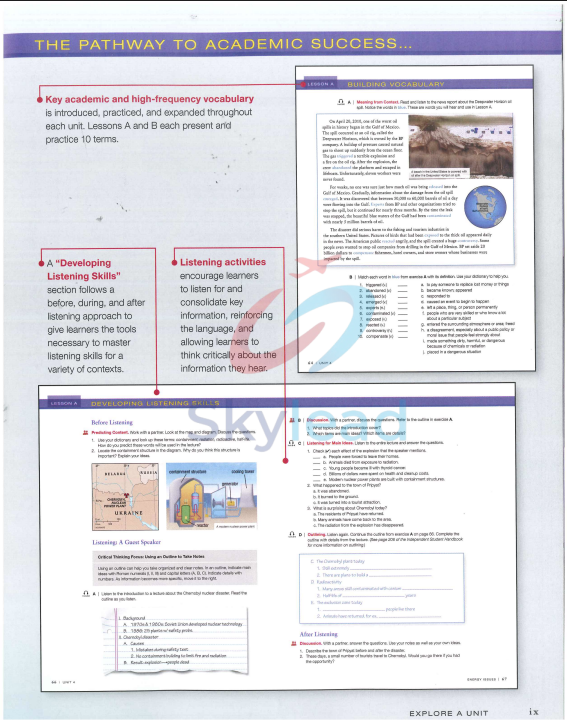
- Key academic and high-frequency vocabulary is introduced, practiced, and expanded throughout each unit. Lessons A and B each present and practice 10 terms.
- A “Developing Listening Skills” section follows a before, during, and after listening approach to give learners the tools necessary to master listening skills for a variety of contexts.
- Listening activities encourage learners to listen for and consolidate key information, reinforcing the language, and allowing learners to think critically about the information they hear.
Nội dung trang mẫu Lesson A – Building Vocabulary:
- A | Meaning from Context. Read and listen to the news report about the Deepwater Horizon oil spill. Notice the words in blue. These are words you will hear and use in Lesson A.
- Đoạn văn: On April 20, 2010, one of the worst oil spills in history began in the Gulf of Mexico… (Các từ in xanh: triggered, abandoned, released, emerged, experts, contaminated, exposed, reacted, controversy, compensate).
- B | Match each word in blue from exercise A with its definition. Use your dictionary to help you. (1. triggered, 2. abandoned, 3. released, 4. emerged, 5. experts, 6. contaminated, 7. exposed, 8. reacted, 9. controversy, 10. compensate).
Nội dung trang mẫu Lesson A – Developing Listening Skills:
- Before Listening:
- Predicting Content. Work with a partner. Look at the map and diagram. Discuss the questions.
- Use your dictionary and look up these terms: containment, radiation, radioactive, half-life. How do you predict these words will be used in the lecture?
- Locate the containment structure in the diagram. Why do you think this structure is important? Explain your ideas.
- Sơ đồ: nuclear power plant (containment structure, cooling tower, generator, reactor).
- Listening: A Guest Speaker
- Critical Thinking Focus: Using an Outline to Take Notes (Sử dụng các chữ số La Mã I, II và các chữ cái A, B…).
- Phần ghi chú viết tay: I. Background; II. Chernobyl disaster (A. Causes, B. Result).
- C | Listening for Main Ideas. Listen to the entire lecture and answer the questions.
- D | Outlining. Listen again. Continue the outline from exercise A on page 66.
Chân trang: ix | EXPLORE A UNIT | ENERGY ISSUES | 67
TRANG 3 (x)
Thanh tiêu đề: THE PATHWAY TO ACADEMIC SUCCESS…
Các điểm ghi chú (Dấu chấm đỏ):
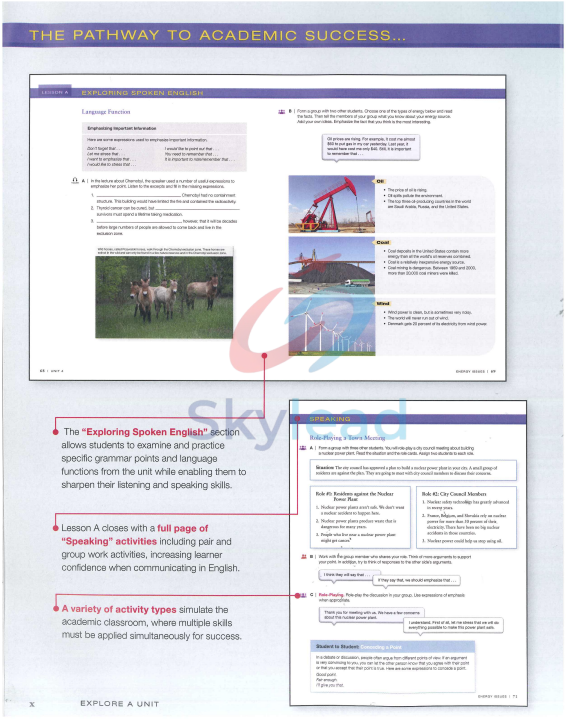
- The “Exploring Spoken English” section allows students to examine and practice specific grammar points and language functions from the unit while enabling them to sharpen their listening and speaking skills.
- Lesson A closes with a full page of “Speaking” activities including pair and group work activities, increasing learner confidence when communicating in English.
- A variety of activity types simulate the academic classroom, where multiple skills must be applied simultaneously for success.
Nội dung trang mẫu Lesson A – Exploring Spoken English:
- Language Function: Emphasizing Important Information
- (Don’t forget that…, Let me stress that…, I want to emphasize that…, I would like to stress that…, I would like to point out that…, You need to remember that…, It is important to note/remember that…).
- A | In the lecture about Chernobyl, the speaker used a number of useful expressions to emphasize her point…
- B | Form a group with three other students. Choose one of the types of energy below and read the facts…
- Các khung thông tin năng lượng:
- Oil: The price of oil is rising; Oil spills pollute the environment; The top three oil-producing countries in the world are Saudi Arabia, Russia, and the United States.
- Coal: Coal deposits in the United States contain more energy than all the world’s oil reserves combined; Coal is a relatively inexpensive energy source; Coal mining is dangerous…
- Wind: Wind power is clean, but is sometimes very noisy; The world will never run out of wind; Denmark gets 20 percent of its electricity from wind power.
Nội dung trang mẫu Speaking:
- Role-Playing a Town Meeting
- A | Form a group with three other students. You will role-play a city council meeting about building a nuclear power plant.
- Situation: The city council has approved a plan to build a nuclear power plant in your city. A small group of residents are against the plan…
- Role #1: Residents against the Nuclear Power Plant (Nuclear power plants aren’t safe; Nuclear power plants produce waste; People who live near a nuclear power plant might get cancer).
- Role #2: City Council Members (Nuclear safety technology has greatly advanced; France, Belgium, and Slovakia rely on nuclear power…; Nuclear power could help us stop using oil).
- C | Role-Playing. Role-play the discussion in your group.
- Student to Student: Conceding a Point (Good point; Fair enough; I’ll give you that).