

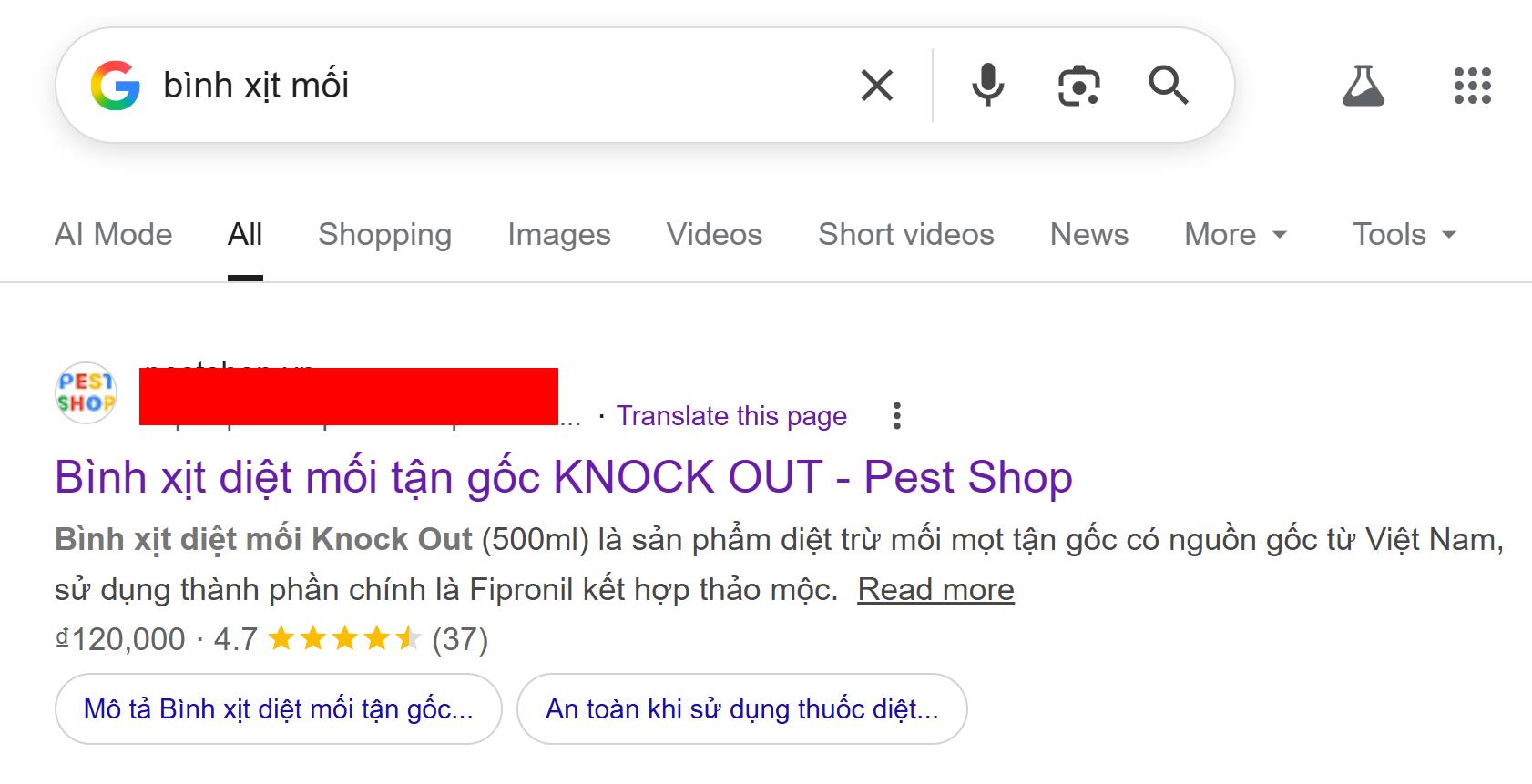
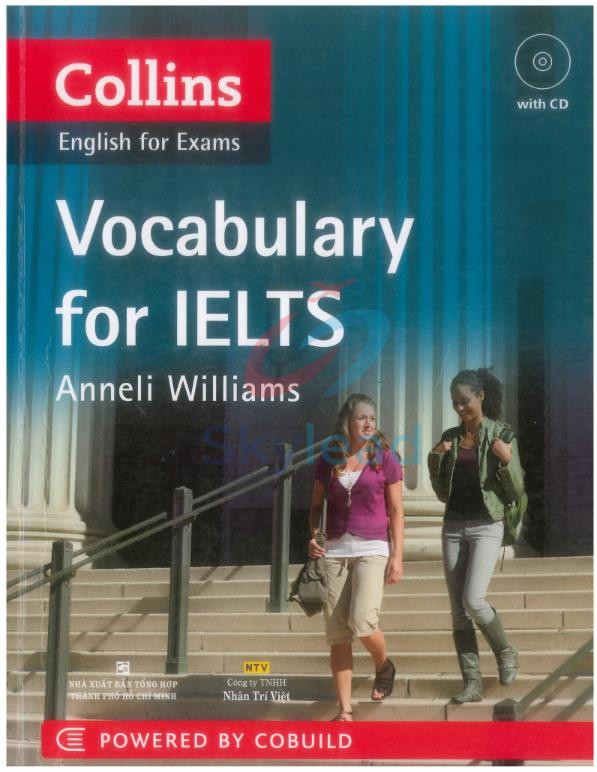

Collins
with CD
English for Exams
Vocabulary
for IELTS
Anneli Williams
NHÀ XUẤT BẢN TỔNG HỢP THÀNH PHỐ HỒ CHÍ MINH
NTV Công ty TNHH Nhân Trí Việt
POWERED BY COBUILD
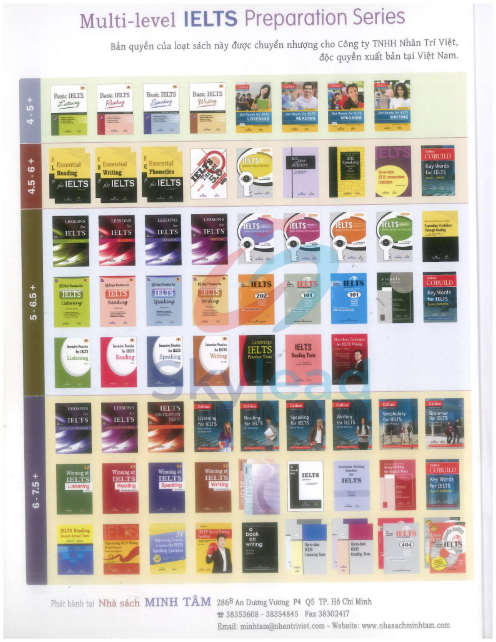
Multi-level IELTS Preparation Series
Bản quyền của loạt sách này được chuyển nhượng cho Công ty TNHH Nhân Trí Việt,
độc quyền xuất bản tại Việt Nam.
4 – 5+
Basic IELTS Listening
Basic IELTS Reading
Basic IELTS Speaking
Basic IELTS Writing
Get Ready for IELTS LISTENING
Get Ready for IELTS READING
Get Ready for IELTS SPEAKING
Get Ready for IELTS WRITING
4.5 – 6+
Essential Reading for IELTS
Essential Writing for IELTS
Essential Phonetics for IELTS
IELTS Target 5.0
COBUILD Key Words for IELTS Book 1: STARTER
5 – 6.5+
LESSONS for IELTS LISTENING
LESSONS for IELTS READING
LESSONS for IELTS SPEAKING
LESSONS for IELTS WRITING
IELTS Target 6.5
Expanding Vocabulary Through Reading
15 Days’ Practice for IELTS Listening
15 Days’ Practice for IELTS Reading
15 Days’ Practice for IELTS Speaking
15 Days’ Practice for IELTS Writing
IELTS 202
IELTS 101
IELTS 101
COBUILD Key Words for IELTS Book 2: IMPROVER
Intensive Practice for IELTS Listening
Intensive Practice for IELTS Reading
Intensive Practice for IELTS Speaking
Intensive Practice for IELTS Writing
Cambridge IELTS Practice Tests
IELTS Reading Tests
Marvelous Techniques for IELTS Writing
6 – 7.5+
LESSONS for IELTS ADVANCED READING
LESSONS for IELTS ADVANCED WRITING
IELTS SIMULATION TESTS
Listening for IELTS
Reading for IELTS
Speaking for IELTS
Writing for IELTS
Vocabulary for IELTS
Grammar for IELTS
Winning at IELTS Listening
Winning at IELTS Reading
Winning at IELTS Speaking
Winning at IELTS Writing
IELTS Target 7.0
A book for IELTS
Academic Writing Practice for IELTS
Essay Writing for English Tests
COBUILD Key Words for IELTS Book 3: ADVANCED
IELTS Reading Recent Actual Tests
High-scoring IELTS Writing Model Answers
31 High-scoring Formulas to Answer the IELTS Speaking Questions
IELTS Special Training Speaking
a book on writing
Up-to-date IELTS Listening Tests
Up-to-date IELTS Reading Tests
IELTS 404
Cracking the IELTS
Phát hành tại Nhà sách MINH TÂM 286B An Dương Vương P4 Q5 TP. Hồ Chí Minh
38353608 – 38354845 Fax 38302417
Email: minhtam@nhantriviet.com – Website: www.nhasachminhtam.com
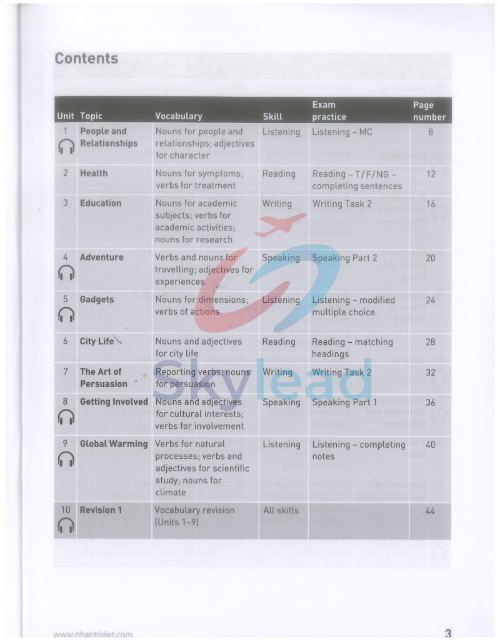
Contents
| Unit | Topic | Vocabulary | Skill | Exam practice | Page number |
| 1 | People and Relationships | Nouns for people and relationships; adjectives for character | Listening | Listening – MC | 8 |
| 2 | Health | Nouns for symptoms; verbs for treatment | Reading | Reading – T/F/NG – completing sentences | 12 |
| 3 | Education | Nouns for academic subjects; verbs for academic activities; nouns for research | Writing | Writing Task 2 | 16 |
| 4 | Adventure | Verbs and nouns for travelling; adjectives for experiences | Speaking | Speaking Part 2 | 20 |
| 5 | Gadgets | Nouns for dimensions; verbs of actions | Listening | Listening – modified multiple choice | 24 |
| 6 | City Life | Nouns and adjectives for city life | Reading | Reading – matching headings | 28 |
| 7 | The Art of Persuasion | Reporting verbs; nouns for persuasion | Writing | Writing Task 2 | 32 |
| 8 | Getting Involved | Nouns and adjectives for cultural interests; verbs for involvement | Speaking | Speaking Part 1 | 36 |
| 9 | Global Warming | Verbs for natural processes; verbs and adjectives for scientific study; nouns for climate | Listening | Listening – completing notes | 40 |
| 10 | Revision 1 | Vocabulary revision (Units 1-9) | All skills | 44 |
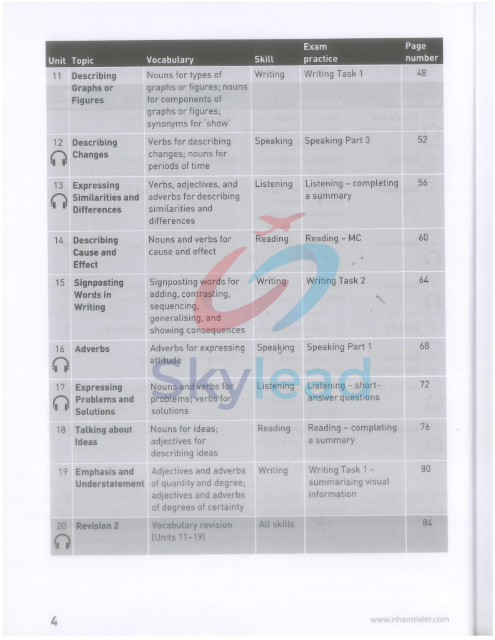
| Unit | Topic | Vocabulary | Skill | Exam practice | Page number |
| 11 | Describing Graphs or Figures | Nouns for types of graphs or figures; nouns for components of graphs or figures; synonyms for ‘show’ | Writing | Writing Task 1 | 48 |
| 12 | Describing Changes | Verbs for describing changes; nouns for periods of time | Speaking | Speaking Part 3 | 52 |
| 13 | Expressing Similarities and Differences | Verbs, adjectives, and adverbs for describing similarities and differences | Listening | Listening – completing a summary | 56 |
| 14 | Describing Cause and Effect | Nouns and verbs for cause and effect | Reading | Reading – MC | 60 |
| 15 | Signposting Words in Writing | Signposting words for adding, contrasting, sequencing, generalising, and showing consequences | Writing | Writing Task 2 | 64 |
| 16 | Adverbs | Adverbs for expressing attitude | Speaking | Speaking Part 1 | 68 |
| 17 | Expressing Problems and Solutions | Nouns and verbs for problems; verbs for solutions | Listening | Listening – short-answer questions | 72 |
| 18 | Talking about Ideas | Nouns for ideas; adjectives for describing ideas | Reading | Reading – completing a summary | 76 |
| 19 | Emphasis and Understatement | Adjectives and adverbs of quantity and degree; adjectives and adverbs of degrees of certainty | Writing | Writing Task 1 – summarising visual information | 80 |
| 20 | Revision 2 | Vocabulary revision (Units 11-19) | All skills | 84 |
Audio scripts 88
Answer key 106
Collocations 113
IELTS information 126
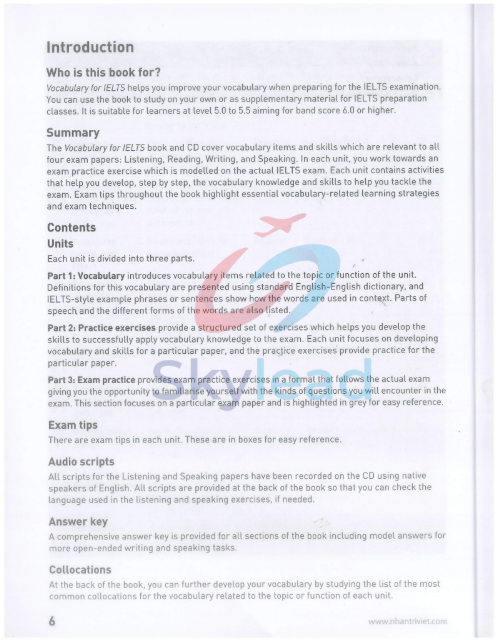
Introduction
Who is this book for?
Vocabulary for IELTS helps you improve your vocabulary when preparing for the IELTS examination. You can use the book to study on your own or as supplementary material for IELTS preparation classes. It is suitable for learners at level 5.0 to 5.5 aiming for band score 6.0 or higher.
Summary
The Vocabulary for IELTS book and CD cover vocabulary items and skills which are relevant to all four exam papers: Listening, Reading, Writing, and Speaking. In each unit, you work towards an exam practice exercise which is modelled on the actual IELTS exam. Each unit contains activities that help you develop, step by step, the vocabulary knowledge and skills to help you tackle the exam. Exam tips throughout the book highlight essential vocabulary-related learning strategies and exam techniques.
Contents
Units
Each unit is divided into three parts.
Part 1: Vocabulary introduces vocabulary items related to the topic or function of the unit. Definitions for this vocabulary are presented using standard English-English dictionary, and IELTS-style example phrases or sentences show how the words are used in context. Parts of speech and the different forms of the words are also listed.
Part 2: Practice exercises provide a structured set of exercises which helps you develop the skills to successfully apply vocabulary knowledge to the exam. Each unit focuses on developing vocabulary and skills for a particular paper, and the practice exercises provide practice for the particular paper.
Part 3: Exam practice provides exam practice exercises in a format that follows the actual exam giving you the opportunity to familiarise yourself with the kinds of questions you will encounter in the exam. This section focuses on a particular exam paper and is highlighted in grey for easy reference.
Exam tips
There are exam tips in each unit. These are in boxes for easy reference.
Audio scripts
All scripts for the Listening and Speaking papers have been recorded on the CD using native speakers of English. All scripts are provided at the back of the book so that you can check the language used in the listening and speaking exercises, if needed.
Answer key
A comprehensive answer key is provided for all sections of the book including model answers for more open-ended writing and speaking tasks.
Collocations
At the back of the book, you can further develop your vocabulary by studying the list of the most common collocations for the vocabulary related to the topic or function of each unit.
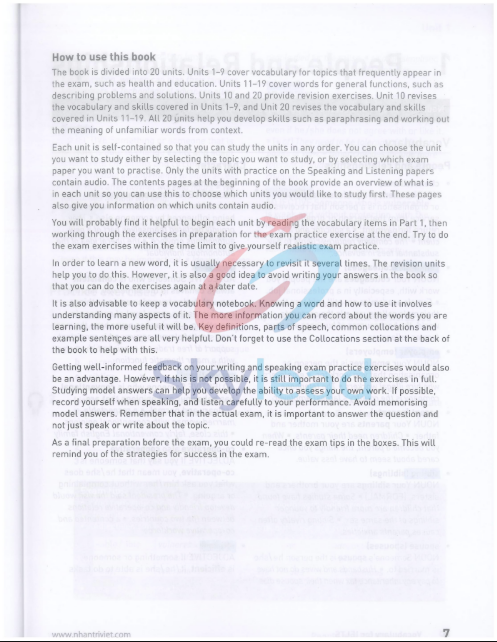
How to use this book
The book is divided into 20 units. Units 1-9 cover vocabulary for topics that frequently appear in the exam, such as health and education. Units 11-19 cover words for general functions, such as describing problems and solutions. Units 10 and 20 provide revision exercises. Unit 10 revises the vocabulary and skills covered in Units 1-9, and Unit 20 revises the vocabulary and skills covered in Units 11-19. All 20 units help you develop skills such as paraphrasing and working out the meaning of unfamiliar words from context.
Each unit is self-contained so that you can study the units in any order. You can choose the unit you want to study either by selecting the topic you want to study, or by selecting which exam paper you want to practise. Only the units with practice on the Speaking and Listening papers contain audio. The contents pages at the beginning of the book provide an overview of what is in each unit so you can use this to choose which units you would like to study first. These pages also give you information on which units contain audio.
You will probably find it helpful to begin each unit by reading the vocabulary items in Part 1, then working through the exercises in preparation for the exam practice exercise at the end. Try to do the exam exercises within the time limit to give yourself realistic exam practice.
In order to learn a new word, it is usually necessary to revisit it several times. The revision units help you to do this. However, it is also a good idea to avoid writing your answers in the book so that you can do the exercises again at a later date.
It is also advisable to keep a vocabulary notebook. Knowing a word and how to use it involves understanding many aspects of it. The more information you can record about the words you are learning, the more useful it will be. Key definitions, parts of speech, common collocations and example sentences are all very helpful. Don’t forget to use the Collocations section at the back of the book to help with this.
Getting well-informed feedback on your writing and speaking exam practice exercises would also be an advantage. However, if this is not possible, it is still important to do the exercises in full. Studying model answers can help you develop the ability to assess your own work. If possible, record yourself when speaking, and listen carefully to your performance. Avoid memorising model answers. Remember that in the actual exam, it is important to answer the question and not just speak or write about the topic.
As a final preparation before the exam, you could re-read the exam tips in the boxes. This will remind you of the strategies for success in the exam.
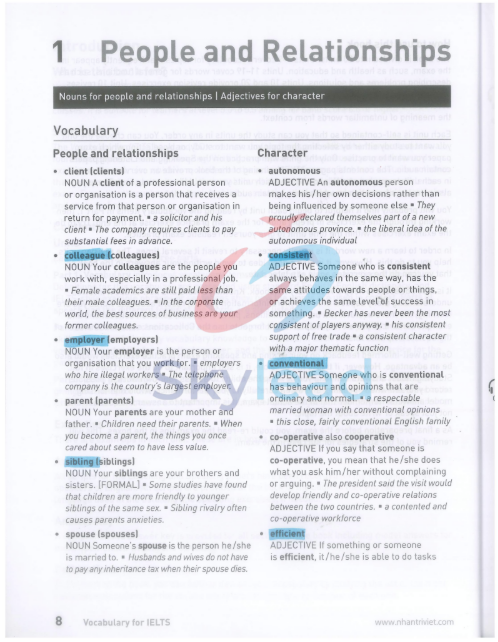
1 People and Relationships
Nouns for people and relationships | Adjectives for character
Vocabulary
People and relationships
• client (clients)
NOUN A client of a professional person or organisation is a person that receives a service from that person or organisation in return for payment. • a solicitor and his client • The company requires clients to pay substantial fees in advance.
• colleague (colleagues)
NOUN Your colleagues are the people you work with, especially in a professional job. • Female academics are still paid less than their male colleagues. • In the corporate world, the best sources of business are your former colleagues.
• employer (employers)
NOUN Your employer is the person or organisation that you work for. • employers who hire illegal workers • The telephone company is the country’s largest employer.
• parent (parents)
NOUN Your parents are your mother and father. • Children need their parents. • When you become a parent, the things you once cared about seem to have less value.
• sibling (siblings)
NOUN Your siblings are your brothers and sisters. [FORMAL] • Some studies have found that children are more friendly to younger siblings of the same sex. • Sibling rivalry often causes parents anxieties.
• spouse (spouses)
NOUN Someone’s spouse is the person he/she is married to. • Husbands and wives do not have to pay any inheritance tax when their spouse dies.
Character
• autonomous
ADJECTIVE An autonomous person makes his/her own decisions rather than being influenced by someone else • They proudly declared themselves part of a new autonomous province. • the liberal idea of the autonomous individual
• consistent
ADJECTIVE Someone who is consistent always behaves in the same way, has the same attitudes towards people or things, or achieves the same level of success in something. • Becker has never been the most consistent of players anyway. • his consistent support of free trade • a consistent character with a major thematic function
• conventional
ADJECTIVE Someone who is conventional has behaviour and opinions that are ordinary and normal. • a respectable married woman with conventional opinions • this close, fairly conventional English family
• co-operative also cooperative
ADJECTIVE If you say that someone is co-operative, you mean that he/she does what you ask him/her without complaining or arguing. • The president said the visit would develop friendly and co-operative relations between the two countries. • a contented and co-operative workforce
• efficient
ADJECTIVE If something or someone is efficient, it/he/she is able to do tasks
8 Vocabulary for IELTS
www.nhantriviet.com
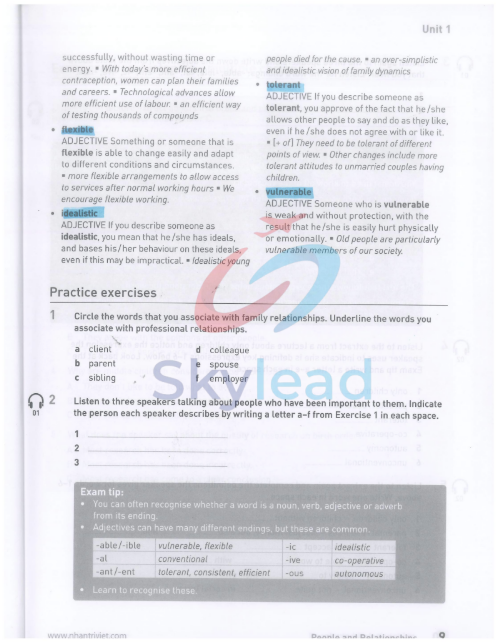
Unit 1
successfully, without wasting time or energy. • With today’s more efficient contraception, women can plan their families and careers. • Technological advances allow more efficient use of labour. • an efficient way of testing thousands of compounds
• flexible
ADJECTIVE Something or someone that is flexible is able to change easily and adapt to different conditions and circumstances. • more flexible arrangements to allow access to services after normal working hours • We encourage flexible working.
• idealistic
ADJECTIVE If you describe someone as idealistic, you mean that he/she has ideals, and bases his/her behaviour on these ideals, even if this may be impractical. • Idealistic young people died for the cause. • an over-simplistic and idealistic vision of family dynamics
• tolerant
ADJECTIVE If you describe someone as tolerant, you approve of the fact that he/she allows other people to say and do as they like, even if he/she does not agree with or like it. • [+ of] They need to be tolerant of different points of view. • Other changes include more tolerant attitudes to unmarried couples having children.
• vulnerable
ADJECTIVE Someone who is vulnerable is weak and without protection, with the result that he/she is easily hurt physically or emotionally. • Old people are particularly vulnerable members of our society.
Practice exercises
1 Circle the words that you associate with family relationships. Underline the words you associate with professional relationships.
a client
b parent
c sibling
d colleague
e spouse
f employer
01
2 Listen to three speakers talking about people who have been important to them. Indicate the person each speaker describes by writing a letter a-f from Exercise 1 in each space.
1 _______________
2 _______________
3 _______________
Exam tip:
• You can often recognise whether a word is a noun, verb, adjective or adverb from its ending.
• Adjectives can have many different endings, but these are common.
-able/-ible vulnerable, flexible
-ic idealistic
-al conventional
-ive co-operative
-ant/-ent tolerant, consistent, efficient
-ous autonomous
• Learn to recognise these.
www.nhantriviet.com People and Relationships 9