

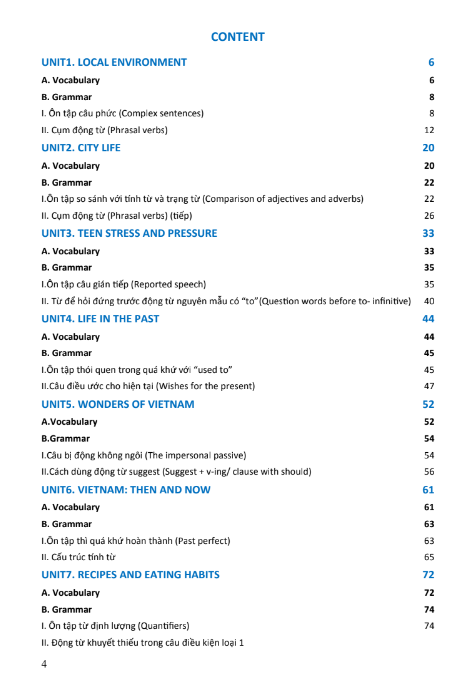

UNIT 1: LOCAL ENVIRONMENT
Vocabulary – Từ vựng
| English word | Vietnamese meaning | Example sentence |
|---|---|---|
| craft (n) | nghề thủ công | Pottery is one of the traditional crafts in Viet Nam. |
| handicraft (n) | sản phẩm thủ công | The village is famous for its handicrafts. |
| set up (v) | thành lập, thiết lập | They set up a workshop to produce silk products. |
| take over (v) | tiếp quản, đảm nhận | When her parents retired, she took over the family business. |
| apprentice (n) | người học việc | The apprentice learned how to make pottery from the master. |
| artisan (n) | thợ thủ công | The artisan skillfully painted the vase. |
| attraction (n) | điểm thu hút, hấp dẫn | Bat Trang village is a tourist attraction in Ha Noi. |
| layer (n) | lớp | The artist applied a layer of paint on the surface. |
| mould (v) | đổ khuôn, tạo hình | The craftsman moulded the clay into a bowl. |
| weave (v) | dệt | They weave baskets from bamboo. |
| lacquerware (n) | đồ sơn mài | Ha Thai village produces beautiful lacquerware. |
| sculpture (n) | điêu khắc | There is a sculpture of a dragon in the centre of the village. |
Grammar – Ngữ pháp
1. Complex sentences – Câu phức
A complex sentence consists of one main clause and one or more subordinate clauses.
(Một câu phức bao gồm một mệnh đề chính và một hoặc nhiều mệnh đề phụ thuộc.)
Examples:
- I learned English because I wanted to study abroad.
- When I arrived home, my parents were cooking.
Common subordinating conjunctions (Liên từ phụ thuộc thường gặp):
| Type | Conjunctions | Example |
|---|---|---|
| Reason (Lý do) | because, since, as | I stayed home because it was raining. |
| Time (Thời gian) | when, while, before, after, as soon as, until | After I finish my homework, I’ll watch TV. |
| Purpose (Mục đích) | so that, in order that | He whispered so that no one could hear him. |
| Condition (Điều kiện) | if, unless, provided that | You can go out if you finish your work. |
| Contrast (Tương phản) | although, though, even though | Although he is young, he is very talented. |
2. Notes – Ghi chú
- Dấu phẩy (comma) không dùng trước mệnh đề phụ bắt đầu bằng các liên từ như because, if, when…
- Nếu mệnh đề phụ đứng đầu câu, cần có dấu phẩy sau nó. When I came home, my brother was watching TV.
Practice – Bài tập
Task 1: Complete the sentences with the suitable subordinating conjunctions.
(Điền liên từ phụ thuộc thích hợp vào chỗ trống.)
- ______ she was tired, she finished all the work.
- I’ll call you ______ I arrive at the station.
- He moved to Ha Noi ______ he wanted to find a better job.
- ______ you study hard, you’ll pass the exam.
- They took an umbrella ______ it was raining.
Phrasal Verbs – Cụm động từ
A phrasal verb consists of a verb and one or more particles (prepositions or adverbs).
(Một cụm động từ gồm động từ chính và một hoặc nhiều tiểu từ.)
| Verb | Particle | Meaning | Example |
|---|---|---|---|
| take | over | tiếp quản | She took over the family workshop. |
| set | up | thành lập | They set up a new craft village. |
| look | through | xem qua, đọc lướt | He looked through the report before the meeting. |
| bring | out | xuất bản, đưa ra thị trường | The company brought out a new product. |
| come | back | trở lại | She came back to her hometown last year. |
| deal | with | giải quyết | They have to deal with customer complaints. |
Exercises – Bài tập ứng dụng
Task 2: Complete the sentences with the correct form of the phrasal verbs.
(Điền đúng dạng của cụm động từ vào chỗ trống.)
- They decided to _______ a small workshop to make lacquerware.
- When his father retired, he _______ the family business.
- The manager will _______ the proposal before the meeting.
- The company will _______ a new design next month.
- After ten years in Ha Noi, she _______ to her village.
Reading – Bài đọc
A visit to Bat Trang pottery village
Bat Trang is a traditional pottery village located on the bank of the Red River, about 13 kilometers from Ha Noi. The village is famous for its high-quality ceramic products, which have been made for hundreds of years. Visitors can learn about the process of making pottery and even try to make their own products under the guidance of local artisans.
The process of making pottery involves several steps. First, the clay is cleaned and mixed until it becomes smooth. Then, it is shaped on a potter’s wheel or moulded by hand. After that, the products are dried, decorated, and glazed. Finally, they are baked in a kiln at a high temperature. Each step requires great skill and patience.
Bat Trang’s pottery is not only sold domestically but also exported to many countries around the world. The village attracts a large number of tourists who come to buy souvenirs and experience the traditional culture of Viet Nam.
Vocabulary – Từ vựng quan trọng trong bài đọc
| Word | Meaning |
|---|---|
| pottery (n) | đồ gốm |
| ceramic (adj) | bằng gốm |
| kiln (n) | lò nung |
| glaze (v) | tráng men |
| export (v) | xuất khẩu |
| souvenir (n) | quà lưu niệm |
Unit 2: City Life – Đời sống thành thị
Vocabulary
| Word | Meaning | Example |
|---|---|---|
| metropolitan (adj) | thuộc đô thị lớn | Ho Chi Minh City is a metropolitan area with millions of people. |
| urban (adj) | thuộc thành phố | Urban areas often have higher living costs. |
| suburban (adj) | thuộc ngoại ô | They live in a suburban district near Ha Noi. |
| downtown (n, adj) | trung tâm thành phố | The hotel is located in downtown Ha Noi. |
| multicultural (adj) | đa văn hóa | London is a multicultural city. |
UNIT 2: CITY LIFE
Grammar – Ngữ pháp
1. Comparative adjectives and adverbs – So sánh tính từ và trạng từ
So sánh trong tiếng Anh dùng để diễn tả sự khác biệt giữa hai hoặc nhiều người / vật / nơi chốn.
a. Comparative form – So sánh hơn
| Type | Rule | Example |
|---|---|---|
| Short adjectives (1 syllable) | adj + -er + than | Ha Noi is bigger than Hue. |
| Adjectives ending in –y | drop -y, add -ier | The countryside is busier than it used to be. |
| Long adjectives (≥2 syllables) | more + adj + than | Ho Chi Minh City is more modern than Ha Noi. |
| Adverbs | more + adv + than | People drive more carefully than before. |
| Irregular forms | good → better / bad → worse / far → farther (further) | The air here is worse than in the countryside. |
b. Superlative form – So sánh nhất
| Type | Rule | Example |
|---|---|---|
| Short adjectives | the + adj + -est | Ha Noi is the largest city in Viet Nam. |
| Long adjectives | the + most + adj | Tokyo is the most expensive city in the world. |
| Irregular forms | good → the best / bad → the worst / far → the farthest | This is the best restaurant in the area. |
c. Notes – Ghi chú
- Nếu tính từ kết thúc bằng -e, chỉ thêm -r / -st large → larger → largest
- Nếu kết thúc bằng một phụ âm, trước đó là một nguyên âm, nhân đôi phụ âm cuối: big → bigger → biggest
- Double comparative (so sánh kép):
Dùng để chỉ xu hướng tăng/giảm song song The more you study, the better you get.
The higher we go, the cooler it becomes.
Practice – Bài tập
Task 1: Complete the sentences with the correct form of the adjectives in brackets.
- Life in the city is __________ (busy) than in the countryside.
- Ho Chi Minh City is __________ (large) than Da Nang.
- This building is __________ (tall) in the town.
- My hometown is becoming __________ (modern) every year.
- The streets are __________ (crowded) during rush hour.
Task 2: Choose the correct option.
- Ha Noi is (more/most) ancient than Ho Chi Minh City.
- This restaurant is (better/best) than the one near my house.
- Singapore is one of (the cleanest/the cleaner) cities in Asia.
- The traffic is getting (badder/worse) every day.
- The air here is (fresher/freshest) than in the centre.
Speaking – Nói
Talking about your city or town
Useful expressions – Cụm từ hữu ích:
- My city is located in… (Thành phố của tôi nằm ở…)
- It’s famous for… (Nó nổi tiếng vì…)
- The city has… (Thành phố có…)
- Compared to…, it’s… (So với…, nó thì…)
- The thing I like most about my city is… (Điều tôi thích nhất ở thành phố của tôi là…)
Example:
My city is Da Nang. It’s located in central Viet Nam and famous for its beaches. Compared to Ha Noi, it’s smaller but cleaner and less crowded. The thing I like most about Da Nang is its friendly people.
Reading – Bài đọc
Life in two cities: Ha Noi and Ho Chi Minh City
Both Ha Noi and Ho Chi Minh City are major cities in Viet Nam. Ha Noi, the capital, is known for its historical sites, old streets, and peaceful atmosphere. In contrast, Ho Chi Minh City is more dynamic and modern, with a large number of businesses and skyscrapers.
The cost of living in Ho Chi Minh City is generally higher than in Ha Noi. However, people there enjoy more job opportunities and a faster pace of life. Ha Noi, on the other hand, is greener and offers more cultural attractions such as museums and ancient temples.
Although the two cities are different, both attract many tourists and play important roles in the country’s development.
Vocabulary – Từ vựng trong bài đọc
| Word | Meaning |
|---|---|
| dynamic (adj) | năng động |
| skyscraper (n) | nhà chọc trời |
| pace of life (n) | nhịp sống |
| attraction (n) | điểm thu hút |
| cultural (adj) | thuộc văn hóa |
Writing – Viết
Write a short paragraph (80–100 words) about the city or town you live in.
(Viết đoạn văn ngắn 80–100 từ về thành phố hoặc thị trấn nơi bạn sống.)
Guidelines – Gợi ý viết:
- Where is it located?
- What is it famous for?
- What do you like and dislike about it?
- How is it different from other cities?
Example:
I live in Hue, a beautiful city in central Viet Nam. It is famous for the ancient citadel and the Huong River. The city is smaller and quieter than Ha Noi, but it’s very peaceful. I like the food here because it’s delicious and cheap. However, the weather is sometimes rainy. In general, Hue is a great place to live.
Tải FREE sách Luyện Chuyên Sâu Ngữ Pháp Và Bài Tập Tiếng Anh 9 PDF
Luyện chuyên sâu Ngữ pháp và Bài tập tiếng Anh 9
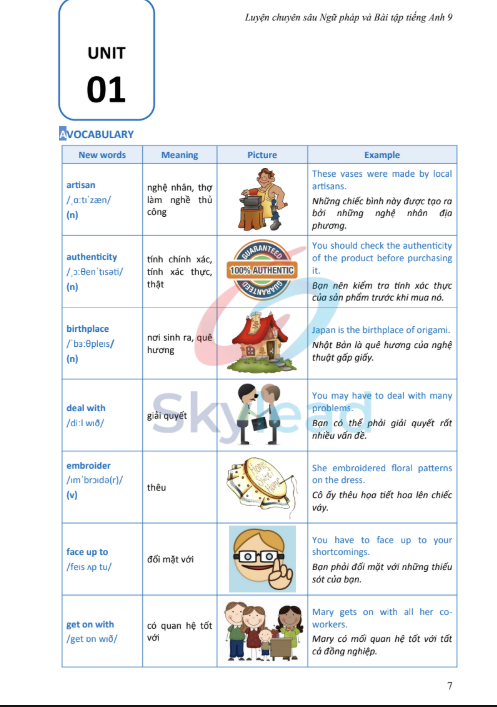
UNIT 01
A. VOCABULARY
| New words | Meaning | Example |
| artisan /ˌɑːtɪˈzæn/ (n) | nghệ nhân, thợ làm nghề thủ công | These vases were made by local artisans. (Những chiếc bình này được tạo ra bởi những nghệ nhân địa phương.) |
| authenticity /ˌɔːθenˈtɪsəti/ (n) | tính chính xác, tính xác thực, thật | You should check the authenticity of the product before purchasing it. (Bạn nên kiểm tra tính xác thực của sản phẩm trước khi mua nó.) |
| birthplace /ˈbɜːθpleɪs/ (n) | nơi sinh ra, quê hương | Japan is the birthplace of origami. (Nhật Bản là quê hương của nghệ thuật gấp giấy.) |
| deal with /diːl wɪð/ | giải quyết | You may have to deal with many problems. (Bạn có thể phải giải quyết rất nhiều vấn đề.) |
| embroider /ɪmˈbrɔɪdə(r)/ (v) | thêu | She embroidered floral patterns on the dress. (Cô ấy thêu họa tiết hoa lên chiếc váy.) |
| face up to /feɪs ʌp tu/ | đối mặt với | You have to face up to your shortcomings. (Bạn phải đối mặt với những thiếu sót của bạn.) |
| get on with /ɡet ɒn wɪð/ | có quan hệ tốt với | Mary gets on with all her co-workers. (Mary có mối quan hệ tốt với tất cả đồng nghiệp.) |
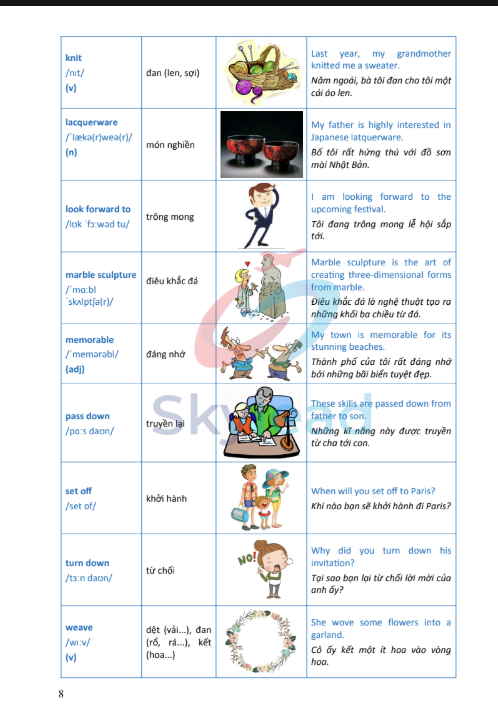
| knit /nɪt/ (v) | đan (len, sợi) | Last year, my grandmother knitted me a sweater. (Năm ngoái, bà tôi đan cho tôi một cái áo len.) |
| lacquerware /ˈlækə(r)weə(r)/ (n) | món đồ sơn mài | My father is highly interested in Japanese lacquerware. (Bố tôi rất hứng thú với đồ sơn mài Nhật Bản.) |
| look forward to /lʊk ˈfɔːwəd tu/ | trông mong | I am looking forward to the upcoming festival. (Tôi đang trông mong lễ hội sắp tới.) |
| marble sculpture /ˈmɑːbl ˈskʌlptʃə(r)/ | điêu khắc đá | Marble sculpture is the art of creating three-dimensional forms from marble. (Điêu khắc đá là nghệ thuật tạo ra những khối ba chiều từ đá.) |
| memorable /ˈmemərəbl/ (adj) | đáng nhớ | My town is memorable for its stunning beaches. (Thành phố của tôi rất đáng nhớ bởi những bãi biển tuyệt đẹp.) |
| pass down /pɑːs daʊn/ | truyền lại | These skills are passed down from father to son. (Những kỹ năng này được truyền từ cha tới con.) |
| set off /set ɒf/ | khởi hành | When will you set off to Paris? (Khi nào bạn sẽ khởi hành đi Paris?) |
| turn down /tɜːn daʊn/ | từ chối | Why did you turn down his invitation? (Tại sao bạn lại từ chối lời mời của anh ấy?) |
| weave /wiːv/ (v) | dệt (vải…), đan (rổ, rá…), kết (hoa…) | She wove some flowers into a garland. (Cô ấy kết một ít hoa vào vòng hoa.) |
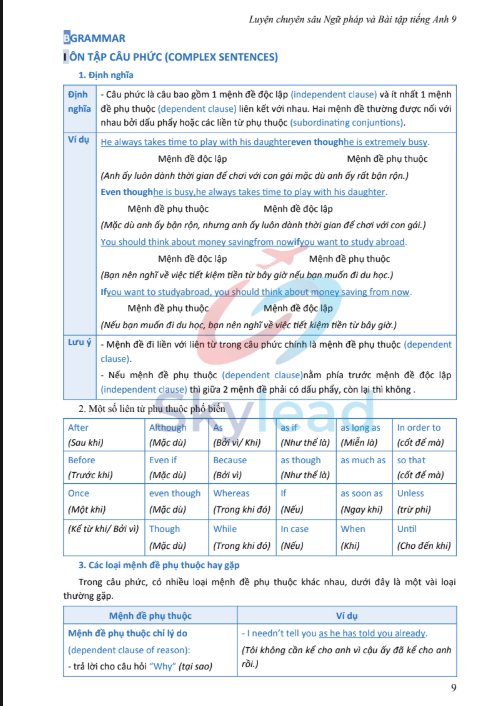
B. GRAMMAR
I. ÔN TẬP CÂU PHỨC (COMPLEX SENTENCES)
1. Định nghĩa
- Định nghĩa: Câu phức là câu bao gồm 1 mệnh đề độc lập (independent clause) và ít nhất 1 mệnh đề phụ thuộc (dependent clause) liên kết với nhau. Hai mệnh đề thường được nối với nhau bởi dấu phẩy hoặc các liên từ phụ thuộc (subordinating conjunctions).
- Ví dụ:
- <u>He always takes time to play with his daughter</u> even though <u>he is extremely busy</u>.
(Mệnh đề độc lập – Mệnh đề phụ thuộc)
(Anh ấy luôn dành thời gian để chơi với con gái mặc dù anh ấy rất bận rộn.) - Even though <u>he is busy</u>, <u>he always takes time to play with his daughter</u>.
(Mệnh đề phụ thuộc – Mệnh đề độc lập)
(Mặc dù anh ấy bận rộn, nhưng anh ấy luôn dành thời gian để chơi với con gái.) - <u>You should think about money saving from now</u> if <u>you want to study abroad</u>.
(Mệnh đề độc lập – Mệnh đề phụ thuộc)
(Bạn nên nghĩ về việc tiết kiệm tiền từ bây giờ nếu bạn muốn đi du học.) - If <u>you want to study abroad</u>, <u>you should think about money saving from now</u>.
(Mệnh đề phụ thuộc – Mệnh đề độc lập)
(Nếu bạn muốn đi du học, bạn nên nghĩ về việc tiết kiệm tiền từ bây giờ.)
- <u>He always takes time to play with his daughter</u> even though <u>he is extremely busy</u>.
- Lưu ý:
- Mệnh đề đi liền với liên từ trong câu phức chính là mệnh đề phụ thuộc (dependent clause).
- Nếu mệnh đề phụ thuộc (dependent clause) nằm phía trước mệnh đề độc lập (independent clause) thì giữa 2 mệnh đề phải có dấu phẩy, còn lại thì không.
2. Một số liên từ phụ thuộc phổ biến
| After (Sau khi) | Although (Mặc dù) | As (Bởi vì/ Khi) | as if (Như thể là) | as long as (Miễn là) | In order to (Cốt để mà) |
| Before (Trước khi) | Even if (Mặc dù) | Because (Bởi vì) | as though (Như thể là) | as much as | so that (Cốt để mà) |
| Once (Một khi) | even though (Mặc dù) | Whereas (Trong khi đó) | If (Nếu) | as soon as (Ngay khi) | Unless (Trừ phi) |
| Since (Kể từ khi/ Bởi vì) | Though (Mặc dù) | While (Trong khi đó) | In case (Nếu) | When (Khi) | Until (Cho đến khi) |
3. Các loại mệnh đề phụ thuộc hay gặp
Trong câu phức, có nhiều loại mệnh đề phụ thuộc khác nhau, dưới đây là một vài loại thường gặp.
| Mệnh đề phụ thuộc | Ví dụ |
| Mệnh đề phụ thuộc chỉ lý do (dependent clause of reason): trả lời cho câu hỏi “Why” (tại sao) | – I needn’t tell you <u>as he has told you already</u>. (Tôi không cần kể cho anh vì cậu ấy đã kể cho anh rồi.) |