

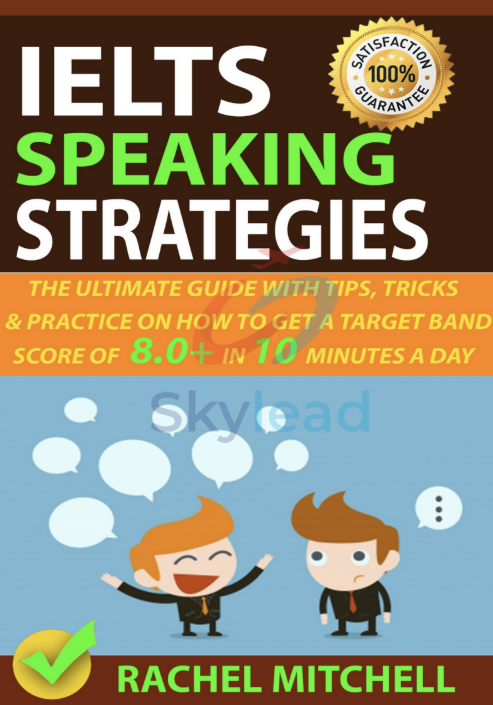
HÌNH 1 (Trang bìa)
IELTS SPEAKING STRATEGIES
THE ULTIMATE GUIDE WITH TIPS, TRICKS & PRACTICE ON HOW TO GET A TARGET BAND SCORE OF 8.0+ IN 10 MINUTES A DAY
[Hình ảnh minh họa: Hai nhân vật hoạt hình đang nói chuyện với các bong bóng thoại]
[Con dấu]: SATISFACTION 100% GUARANTEE
RACHEL MITCHELL
HÌNH 2
Text Copyright © by Rachel Mitchell
All rights reserved. No part of this guide may be reproduced in any form without permission in writing from the publisher except in the case of brief quotations embodied in critical articles or reviews.
Legal & Disclaimer
The information contained in this book and its contents is not designed to replace or take the place of any form of medical or professional advice; and is not meant to replace the need for independent medical, financial, legal or other professional advice or services, as may be required. The content and information in this book have been provided for educational and entertainment purposes only.
The content and information contained in this book have been compiled from sources deemed reliable, and it is accurate to the best of the Author’s knowledge, information, and belief. However, the Author cannot guarantee its accuracy and validity and cannot be held liable for any errors and/or omissions. Further, changes are periodically made to this book as and when needed. Where appropriate and/or necessary, you must consult a professional (including but not limited to your doctor, attorney, financial advisor or such other professional advisor) before using any of the suggested remedies, techniques, or information in this book.
Upon using the contents and information contained in this book, you agree to hold harmless the Author from and against any damages, costs, and expenses, including any legal fees potentially resulting from the application of any of the information provided by this book. This disclaimer applies to any loss, damages or injury caused by the use and application, whether directly or indirectly, of any advice or information presented, whether for breach of contract, tort, negligence, personal injury, criminal intent, or under any other cause of action.
You agree to accept all risks of using the information presented inside this book.
You agree that by continuing to read this book, where appropriate and/or necessary, you shall consult a professional (including but not limited to your doctor, attorney, or financial advisor or such other advisor as needed) before using any of the suggested remedies, techniques, or information in this book.
HÌNH 3
INTRODUCTION
Thank you and congratulate you for downloading the book “IELTS Speaking Strategies: The Ultimate Guide with Tips, Tricks and Practice on How to Get a Target Band Score of 8.0+ in 10 Minutes a Day.”
This book is well designed and written by an experienced native teacher from the USA who has been teaching IELTS for over 10 years. She really is the expert in training IELTS for students at each level. In this book, she will provide you all proven Formulas, Tips, Tricks, Strategies, Explanations, Structures, Part 1 + Part 2 + Part 3 Speaking Language, Vocabulary and Model Part 1 + Part 2 + Part 3 Answers to help you easily achieve an 8.0+ in the IELTS Speaking, even if your speaking is not excellent. This book will also walk you through step-by-step on how to develop your well-organized answers for the Part 1 + Part 2 + Part 3 Speaking; clearly analyze and explain the different types of questions that are asked for the IELTS Speaking Test; provide you step-by-step instructions on how to answer each type of question excellently.
As the author of this book, Rachel Mitchell believes that this book will be an indispensable reference and trusted guide for you who may want to maximize your band score in IELTS Speaking. Once you read this book, I guarantee you that you will have learned an extraordinarily wide range of useful, and practical IELTS Part 1 + Part 2 + Part 3 Speaking strategies and formulas that will help you become a successful IELTS taker as well as you will even become a successful English user in work and in life within a short period of time only.
Take action today and start getting better scores tomorrow!
Thank you again for purchasing this book, and I hope you enjoy it.
HÌNH 4
PART 1 SPEAKING TOPICS
The skills in part 1 speaking are exactly the skills that we need for part 2 and part 3 speaking. So what we need to do in part 1 speaking is we need to focus on building basic skills.
There are two purposes to part 1 speaking. The first purpose is to calm you down. They know that you are nervous, so they’re going to ask you simple questions that get you settle down and prepare for part 2 & part 3 speaking (the more difficult parts). The second purpose of part 1 speaking is of course for you to show the examiner your ability to speak English. They want you to calm down and they want you to show the most you can do with your English.
In part 1 speaking, the questions are about you, your home, your life, your family, or your country, which are things that you have the answer to. They are not asking you questions like “who wants to be a billionaire?”, “who was the 15th president of the United States?”. Normally, in part 1 speaking, they will be giving you 3 topics:
The 1st topic: The first topic will always be “do you work or do you study?” or “where you are living?”
If you answer that you are working, then they will ask you about your work.
If you answer that you are studying, then they will ask you about your study.
The next 2nd and 3rd topics: The next 2nd and 3rd topics can be about anything, but it is not going to be a sensitive topic; they are not going to ask you about politics. Instead, they will ask you something about general topics that you have ideas to answer. These things might be about rain, for example, how often does it rain in your country? Or how do you feel when it rains?. They also might ask you questions about movies, colors, hobbies, etc. These are simple questions, they are not challenging questions, but we cannot easily predict what the examiner will be asking you about.
Here is the thing. The examiner doesn’t care about your answer. If they ask you “do you like to read?” they don’t care if you say “yes, I love reading” or “no, I hate it”. They don’t care, they want to hear how you communicate.
HÌNH 5
WHAT WILL GIVE YOU A HIGH SCORE IN THE SPEAKING PART 1?
Rule Number 1: Answer the question. Make sure you answer the question.
For example: do you like to read books?
Well, books are really enjoyable. People like to read books because they find it very relaxing, and they can get a lot of information from books. My father really enjoys reading; and every Friday night, he sits at home with a book and drinks some tea….
Am I answering the question? No, I am not.
Definitely, the examiner does know that I did not answer the question because I chose not to. I didn’t answer the question.
Rule Number 2: you need to show the examiner something or some things about your English ability, and that can be something about your grammar, something about your vocabulary, something about the organization of your answer, and maybe something about your pronunciation.
We must know that IELTS is a game, and a test is a method with rules that allows you to gain points and lose points. Therefore, in order to be successful with any game and IELTS in particular, we need to know what the rules are, and we need to know how to gain points, not lose points.
Example: “Do you enjoy reading?”
Answer 1: Yes, I love to read
Answer 2: To be honest, I hate reading. I think it’s a stupid hobby. I think people that read are actually very boring and they annoy me tremendously.
Which answer is better? The first one or the second one? Of course, the second one. Even though the second answer is a bit strange, a bit rude, but that’s not what the examiner will mark in the IELTS exam. Good vocabulary, good grammar, good sentence structures; that is what they mark. So, show the examiner your English ability.
Note that never give a one-word answer, always use complete sentences or at least complete phrases, and extend your answer by providing some kinds of explanations or descriptions.
For example: “Do you enjoy reading?”
Answer: “yes”
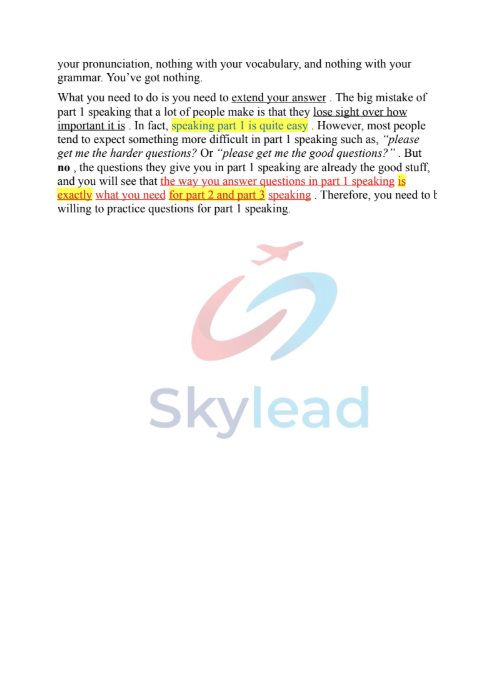
Well, if you just give a one-word answer like this, you’ve got nothing with
HÌNH 6
your pronunciation, nothing with your vocabulary, and nothing with your grammar. You’ve got nothing.
What you need to do is you need to extend your answer. The big mistake of part 1 speaking that a lot of people make is that they lose sight over how important it is. In fact, speaking part 1 is quite easy. However, most people tend to expect something more difficult in part 1 speaking such as, “please get me the harder questions? Or “please get me the good questions?”. But no, the questions they give you in part 1 speaking are already the good stuff, and you will see that the way you answer questions in part 1 speaking is exactly what you need for part 2 and part 3 speaking. Therefore, you need to be willing to practice questions for part 1 speaking.
HÌNH 7
HOW DOES THE EXAMINER MARK YOUR SPEAKING TEST?
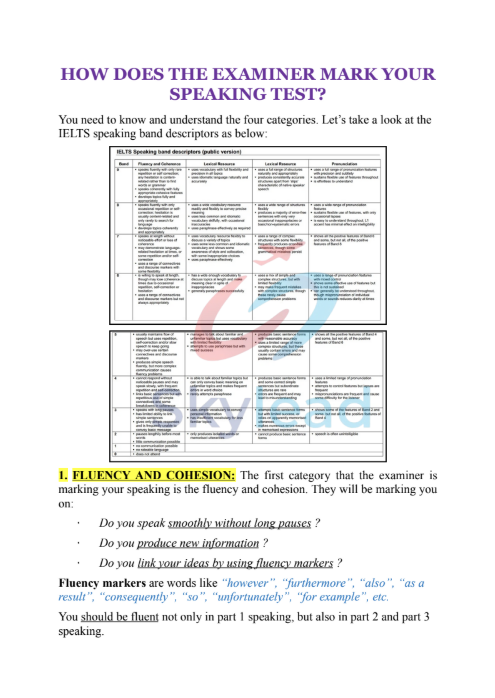
You need to know and understand the four categories. Let’s take a look at the IELTS speaking band descriptors as below:
[Bảng biểu: IELTS Speaking band descriptors (public version)]
(Nội dung bảng bao gồm các tiêu chí cho các mức Band từ 0 đến 9 qua 4 cột: Fluency and Coherence, Lexical Resource, Grammatical Range and Accuracy, Pronunciation)
1. FLUENCY AND COHESION: The first category that the examiner is marking your speaking is the fluency and cohesion. They will be marking you on:
- Do you speak smoothly without long pauses?
- Do you produce new information?
- Do you link your ideas by using fluency markers?
Fluency markers are words like “however”, “furthermore”, “also”, “as a result”, “consequently”, “so”, “unfortunately”, “for example”, etc.
You should be fluent not only in part 1 speaking, but also in part 2 and part 3 speaking.
HÌNH 8
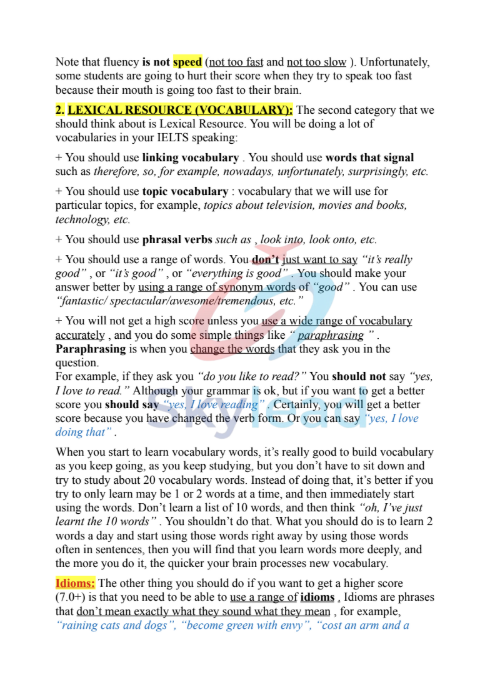
Note that fluency is not speed (not too fast and not too slow). Unfortunately, some students are going to hurt their score when they try to speak too fast because their mouth is going too fast to their brain.
2. LEXICAL RESOURCE (VOCABULARY): The second category that we should think about is Lexical Resource. You will be doing a lot of vocabularies in your IELTS speaking:
+ You should use linking vocabulary. You should use words that signal such as therefore, so, for example, nowadays, unfortunately, surprisingly, etc.
+ You should use topic vocabulary: vocabulary that we will use for particular topics, for example, topics about television, movies and books, technology, etc.
+ You should use phrasal verbs such as, look into, look onto, etc.
+ You should use a range of words. You don’t just want to say “it’s really good”, or “it’s good”, or “everything is good”. You should make your answer better by using a range of synonym words of “good”. You can use “fantastic/ spectacular/awesome/tremendous, etc.”
+ You will not get a high score unless you use a wide range of vocabulary accurately, and you do some simple things like “paraphrasing”. Paraphrasing is khi bạn change the words that they ask you in the question.
For example, if they ask you “do you like to read?” You should not say “yes, I love to read.” Although your grammar is ok, but if you want to get a better score you should say “yes, I love reading”. Certainly, you will get a better score because you have changed the verb form. Or you can say “yes, I love doing that”.
When you start to learn vocabulary words, it’s really good to build vocabulary as you keep going, as you keep studying, but you don’t have to sit down and try to study about 20 vocabulary words. Instead of doing that, it’s better if you try to only learn may be 1 or 2 words at a time, and then immediately start using the words. Don’t learn a list of 10 words, and then think “oh, I’ve just learnt the 10 words”. You shouldn’t do that. What you should do is to learn 2 words a day and start using those words right away by using those words often in sentences, then you will find that you learn words more deeply, and the more you do it, the quicker your brain processes new vocabulary.
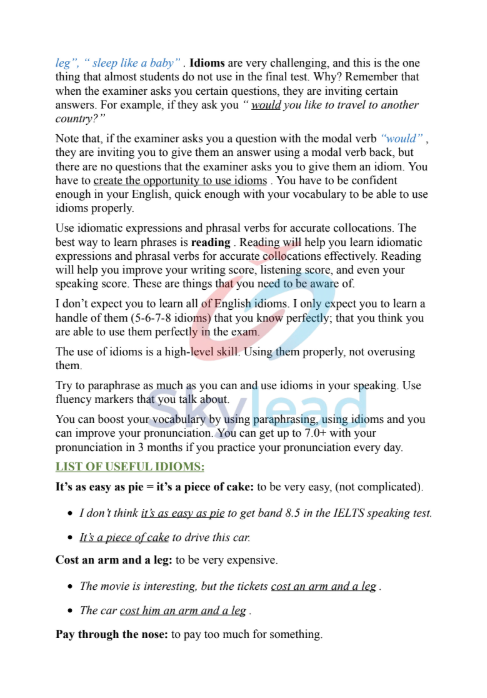
Idioms: The other thing you should do if you want to get a higher score (7.0+) is that you need to be able to use a range of idioms. Idioms are phrases that don’t mean exactly what they sound what they mean, for example, “raining cats and dogs”, “become green with envy”, “cost an arm and a leg”, “sleep like a baby”. Idioms are very challenging, and this is the one thing that almost students do not use in the final test. Why? Remember that when the examiner asks you certain questions, they are inviting certain answers. For example, if they ask you “would you like to travel to another country?”
Note that, if the examiner asks you a question with the modal verb “would”, they are inviting you to give them an answer using a modal verb back, but there are no questions that the examiner asks you to give them an idiom. You have to create the opportunity to use idioms. You have to be confident enough in your English, quick enough with your vocabulary to be able to use idioms properly.
Use idiomatic expressions and phrasal verbs for accurate collocations. The best way to learn phrases is reading. Reading will help you learn idiomatic expressions and phrasal verbs for accurate collocations effectively. Reading will help you improve your writing score, listening score, and even your speaking score. These are things that you need to be aware of.
I don’t expect you to learn all of English idioms. I only expect you to learn a handle of them (5-6-7-8 idioms) that you know perfectly; that you think you are able to use them perfectly in the exam.
The use of idioms is a high-level skill. Using them properly, not overusing them.
Try to paraphrase as much as you can and use idioms in your speaking. Use fluency markers that you talk about.
You can boost your vocabulary by using paraphrasing, using idioms and you can improve your pronunciation. You can get up to 7.0+ with your pronunciation in 3 months if you practice your pronunciation every day.
LIST OF USEFUL IDIOMS:
It’s as easy as pie = it’s a piece of cake: to be very easy, (not complicated).
- I don’t think it’s as easy as pie to get band 8.5 in the IELTS speaking test.
- It’s a piece of cake to drive this car.
Cost an arm and a leg: to be very expensive.
- The movie is interesting, but the tickets cost an arm and a leg.
- The car cost him an arm and a leg.
Pay through the nose: to pay too much for something.