




HÌNH 1: TRANG BÌA
A CREATIVE TEXTBOOK IN
IELTS WRITING
by Le Huynh Duc
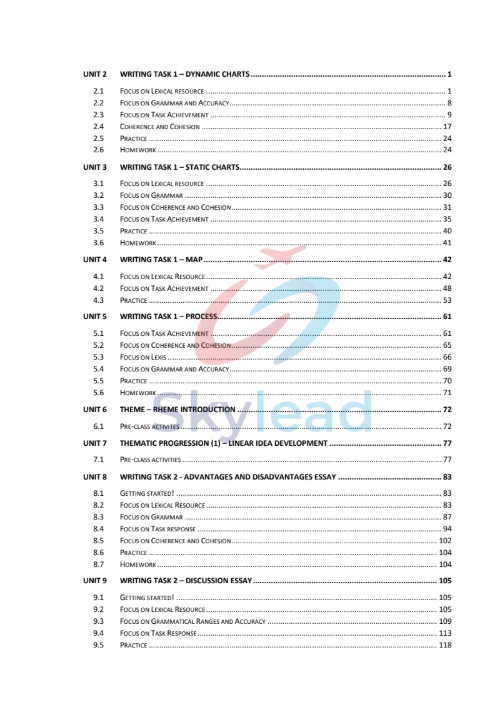
HÌNH 2: MỤC LỤC (TRANG 1)
UNIT 2 WRITING TASK 1 – DYNAMIC CHARTS ……………………………………………………………… 1
2.1 FOCUS ON LEXICAL RESOURCE ………………………………………………………………………………………….. 1
2.2 FOCUS ON GRAMMAR AND ACCURACY ……………………………………………………………………………. 8
2.3 FOCUS ON TASK ACHIEVEMENT ………………………………………………………………………………………. 9
2.4 COHERENCE AND COHESIN ……………………………………………………………………………………………. 17
2.5 PRACTICE …………………………………………………………………………………………………………………… 24
2.6 HOMEWORK ……………………………………………………………………………………………………………….. 24
UNIT 3 WRITING TASK 1 – STATIC CHARTS ………………………………………………………………….. 26
3.1 FOCUS ON LEXICAL RESOURCE ……………………………………………………………………………………….. 26
3.2 FOCUS ON GRAMMAR ………………………………………………………………………………………………….. 30
3.3 FOCUS ON COHERENCE AND COHESION …………………………………………………………………………… 31
3.4 FOCUS ON TASK ACHIEVEMENT ………………………………………………………………………………………. 35
3.5 PRACTICE …………………………………………………………………………………………………………………… 40
3.6 HOMEWORK ……………………………………………………………………………………………………………….. 41
UNIT 4 WRITING TASK 1 – MAP ………………………………………………………………………………….. 42
4.1 FOCUS ON LEXICAL RESOURCE ……………………………………………………………………………………….. 42
4.2 FOCUS ON TASK ACHIEVEMENT ………………………………………………………………………………………. 48
4.3 PRACTICE …………………………………………………………………………………………………………………… 53
UNIT 5 WRITING TASK 1 – PROCESS ……………………………………………………………………………. 61
5.1 FOCUS ON TASK ACHIEVEMENT ………………………………………………………………………………………. 61
5.2 FOCUS ON COHERENCE AND COHESION …………………………………………………………………………… 65
5.3 FOCUS ON LEXIS ………………………………………………………………………………………………………….. 66
5.4 FOCUS ON GRAMMAR AND ACCURACY ……………………………………………………………………………. 69
5.5 PRACTICE …………………………………………………………………………………………………………………… 70
5.6 HOMEWORK ……………………………………………………………………………………………………………….. 71
UNIT 6 THEME – RHEME INTRODUCTION ……………………………………………………………………. 72
6.1 PRE-CLASS ACTIVITES …………………………………………………………………………………………………… 72
UNIT 7 THEMATIC PROGRESSION (1) – LINEAR IDEA DEVELOPMENT ……………………………….. 77
7.1 PRE-CLASS ACTIVITIES …………………………………………………………………………………………………… 77
UNIT 8 WRITING TASK 2 – ADVANTAGES AND DISADVANTAGES ESSAY …………………………….. 83
8.1 GETTING STARTED! ……………………………………………………………………………………………………… 83
8.2 FOCUS ON LEXICAL RESOURCE ……………………………………………………………………………………….. 83
8.3 FOCUS ON GRAMMAR ………………………………………………………………………………………………….. 87
8.4 FOCUS ON TASK RESPONSE …………………………………………………………………………………………… 94
8.5 FOCUS ON COHERENCE AND COHESION …………………………………………………………………………. 102
8.6 PRACTICE …………………………………………………………………………………………………………………. 104
8.7 HOMEWORK ……………………………………………………………………………………………………………… 104
UNIT 9 WRITING TASK 2 – DISCUSSION ESSAY ……………………………………………………………… 105
9.1 GETTING STARTED! ……………………………………………………………………………………………………. 105
9.2 FOCUS ON LEXICAL RESOURCE ……………………………………………………………………………………… 105
9.3 FOCUS ON GRAMMATICAL RANGES AND ACCURACY ……………………………………………………….. 109
9.4 FOCUS ON TASK RESPONSE …………………………………………………………………………………………. 113
9.5 PRACTICE …………………………………………………………………………………………………………………. 118
HÌNH 3: MỤC LỤC (TRANG 2)
9.6 HOMEWORK ……………………………………………………………………………………………………………… 119
UNIT 10 WRITING TASK 2 – CAUSES – EFFECTS – SOLUTIONS ESSAY ………………………………… 120
10.1 GETTING STARTED! ……………………………………………………………………………………………………. 120
10.2 FOCUS ON LEXICAL RESOURCE ……………………………………………………………………………………… 120
10.3 FOCUS ON COHERENCE AND COHESION …………………………………………………………………………. 125
10.4 FOCUS ON TASK RESPONSE …………………………………………………………………………………………. 126
10.5 PRACTICE …………………………………………………………………………………………………………………. 131
10.6 HOMEWORK ……………………………………………………………………………………………………………… 133
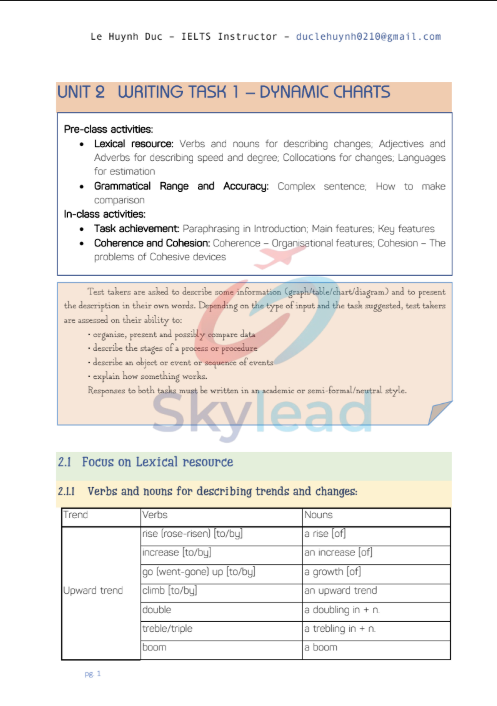
HÌNH 4: TRANG 1
UNIT 2 WRITING TASK 1 – DYNAMIC CHARTS
Pre-class activities:
- Lexical resource: Verbs and nouns for describing changes; Adjectives and Adverbs for describing speed and degree; Collocations for changes; Languages for estimation
- Grammatical Range and Accuracy: Complex sentence, How to make comparison
In-class activities:
- Task achievement: Paraphrasing in Introduction; Main features; Key features
- Coherence and Cohesion: Coherence – Organisational features; Cohesion – The problems of Cohesive devices
Test takers are asked to describe some information (graph/table/chart/diagram) and to present the description in their own words. Depending on the type of input and the task suggested, test takers are assessed on their ability to:
- organise, present and possibly compare data
- describe the stages of a process or procedure
- describe an object or event or sequence of events
- explain how something works.
Responses to both tasks must be written in an academic or semi-formal/neutral style.
2.1 Focus on Lexical resource
2.1.1 Verbs and nouns for describing trends and changes:
| Trend | Verbs | Nouns |
| Upward trend | rise (rose-risen) [to/by] | a rise [of] |
| increase [to/by] | an increase [of] | |
| go (went-gone) up [to/by] | a growth [of] | |
| climb [to/by] | an upward trend | |
| double | a doubling in + n. | |
| treble/triple | a trebling in + n. | |
| boom | a boom |
Pg. 1
HÌNH 5: TRANG 2
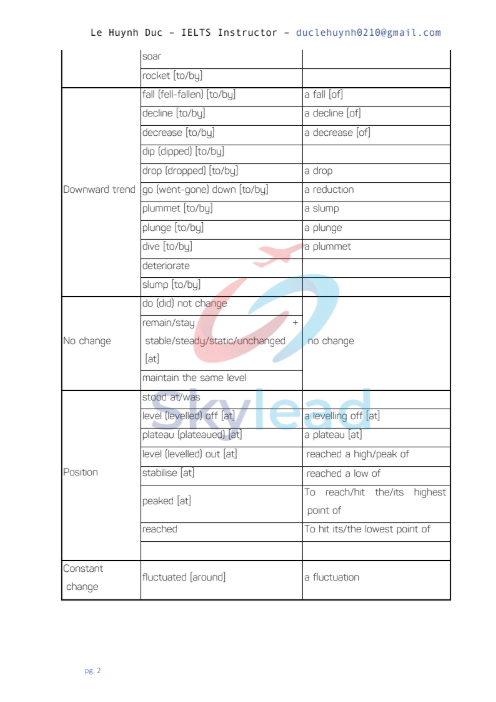
(Tiếp tục bảng từ hình 4)
| | soar | |
| :— | :— | :— |
| | rocket [to/by] | |
| Downward trend| fall (fell-fallen) [to/by] | a fall [of] |
| | decline [to/by] | a decline [of] |
| | decrease [to/by] | a decrease [of] |
| | dip (dipped) [to/by] | |
| | drop (dropped) [to/by] | a drop |
| | go (went-gone) down [to/by] | a reduction |
| | plummet [to/by] | a slump |
| | plunge [to/by] | a plunge |
| | dive [to/by] | a plummet |
| | deteriorate | |
| | slump [to/by] | |
| No change | do (did) not change | |
| | remain/stay + stable/steady/static/unchanged [at] | no change |
| | maintain the same level | |
| Position | stood at/was | |
| | level (levelled) off [at] | a levelling off [at] |
| | plateau (plateaued) [at] | a plateau [at] |
| | level (levelled) out [at] | reached a high/peak of |
| | stabilise [at] | reached a low of |
| | peaked [at] | To reach/hit the/its highest point of |
| | reached | To hit its/the lowest point of |
| Constant change| fluctuated [around] | a fluctuation |
Pg. 2
HÌNH 6: TRANG 3
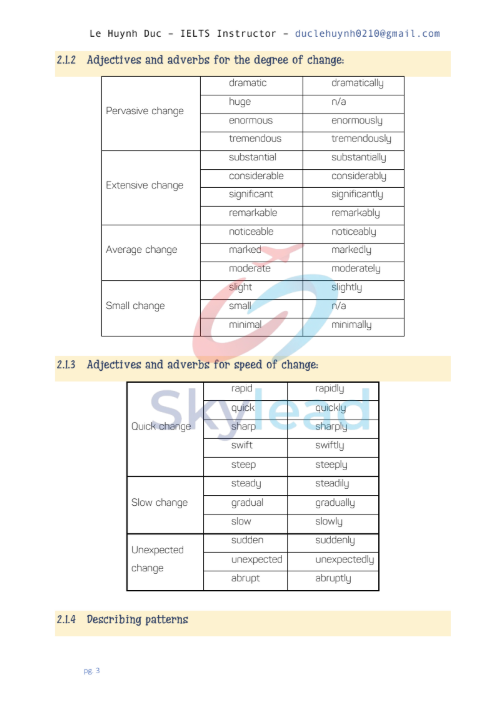
2.1.2 Adjectives and adverbs for the degree of change:
| Category | Adjectives | Adverbs |
| Pervasive change | dramatic | dramatically |
| huge | n/a | |
| enormous | enormously | |
| tremendous | tremendously | |
| Extensive change | substantial | substantially |
| considerable | considerably | |
| significant | significantly | |
| remarkable | remarkably | |
| Average change | noticeable | noticeably |
| marked | markedly | |
| moderate | moderately | |
| Small change | slight | slightly |
| small | n/a | |
| minimal | minimally |
2.1.3 Adjectives and adverbs for speed of change:
| Category | Adjectives | Adverbs |
| Quick change | rapid | rapidly |
| quick | quickly | |
| sharp | sharply | |
| swift | swiftly | |
| steep | steeply | |
| Slow change | steady | steadily |
| gradual | gradually | |
| slow | slowly | |
| Unexpected change | sudden | suddenly |
| unexpected | unexpectedly | |
| abrupt | abruptly |
2.1.4 Describing patterns
Pg. 3
HÌNH 7: TRANG 4
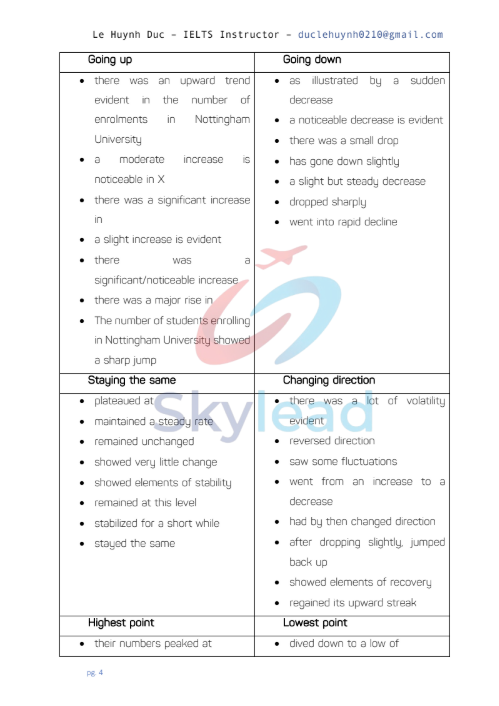
| Going up | Going down |
| – there was an upward trend evident in the number of enrolments in Nottingham University | – as illustrated by a sudden decrease |
| – a moderate increase is noticeable in X | – a noticeable decrease is evident |
| – there was a significant increase in | – there was a small drop |
| – a slight increase is evident | – has gone down slightly |
| – there was a significant/noticeable increase | – a slight but steady decrease |
| – there was a major rise in | – dropped sharply |
| – The number of students enrolling in Nottingham University showed a sharp jump | – went into rapid decline |
| Staying the same | Changing direction |
| – plateaued at | – there was a lot of volatility evident |
| – maintained a steady rate | – reversed direction |
| – remained unchanged | – saw some fluctuations |
| – showed very little change | – went from an increase to a decrease |
| – showed elements of stability | – had by then changed direction |
| – remained at this level | – after dropping slightly, jumped back up |
| – stabilized for a short while | – showed elements of recovery |
| – stayed the same | – regained its upward streak |
| Highest point | Lowest point |
| – their numbers peaked at | – dived down to a low of |
Pg. 4
HÌNH 8: TRANG 5
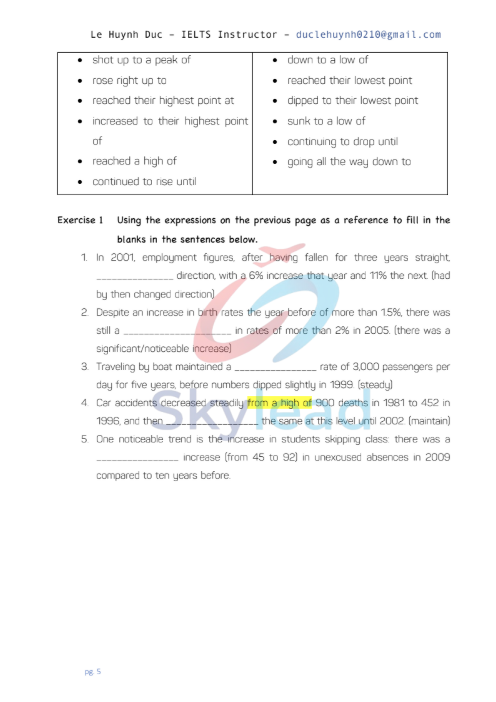
(Tiếp tục phần “Highest point” và “Lowest point”)
| |
| :— |
| – shot up to a peak of | – down to a low of |
| – rose right up to | – reached their lowest point |
| – reached their highest point at | – dipped to their lowest point |
| – increased to their highest point of | – sunk to a low of |
| – reached a high of | – continuing to drop until |
| – continued to rise until | – going all the way down to |
Exercise 1 Using the expressions on the previous page as a reference to fill in the blanks in the sentences below.
- In 2001, employment figures, after having fallen for three years straight, _________________ direction, with a 6% increase that year and 11% the next. (had by then changed direction)
- Despite an increase in birth rates the year before of more than 1.5%, there was still a _________________ in rates of more than 2% in 2005. (there was a significant/noticeable increase)
- Traveling by boat maintained a _________________ rate of 3,000 passengers per day for five years, before numbers dipped slightly in 1999. (steady)
- Car accidents decreased steadily from a high of 900 deaths in 1981 to 452 in 1996, and then _________________ the same at this level until 2002. (maintain)
- One noticeable trend is the increase in students skipping class: there was a _________________ increase (from 45 to 92) in unexcused absences in 2009 compared to ten years before.
Pg. 5
HÌNH 9: TRANG 6
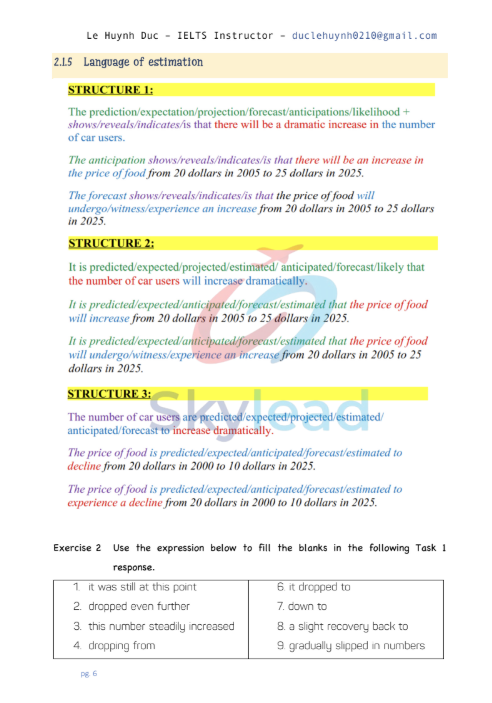
2.1.5 Language of estimation
STRUCTURE 1:
The prediction/expectation/projection/forecast/anticipations/likelihood + shows/reveals/indicates/is that there will be a dramatic increase in the number of car users.
The anticipation shows/reveals/indicates/is that there will be an increase in the price of food from 20 dollars in 2005 to 25 dollars in 2025.
The forecast shows/reveals/indicates/is that the price of food will undergo/witness/experience an increase from 20 dollars in 2005 to 25 dollars in 2025.
STRUCTURE 2:
It is predicted/expected/projected/estimated/ anticipated/forecast/likely that the number of car users will increase dramatically.
It is predicted/expected/anticipated/forecast/estimated that the price of food will increase from 20 dollars in 2005 to 25 dollars in 2025.
It is predicted/expected/anticipated/forecast/estimated that the price of food will undergo/witness/experience an increase from 20 dollars in 2005 to 25 dollars in 2025.
STRUCTURE 3:
The number of car users are predicted/expected/projected/estimated/anticipated/forecast to increase dramatically.
The price of food is predicted/expected/anticipated/forecast/estimated to decline from 20 dollars in 2000 to 10 dollars in 2025.
The price of food is predicted/expected/anticipated/forecast/estimated to experience a decline from 20 dollars in 2000 to 10 dollars in 2025.
Exercise 2 Use the expression below to fill the blanks in the following Task 1 response.
- it was still at this point | 6. it dropped to
- dropped even further | 7. down to
- this number steadily increased | 8. a slight recovery back to
- dropping from | 9. gradually slipped in numbers
Pg. 6