


HÌNH 1 (Trang bìa)
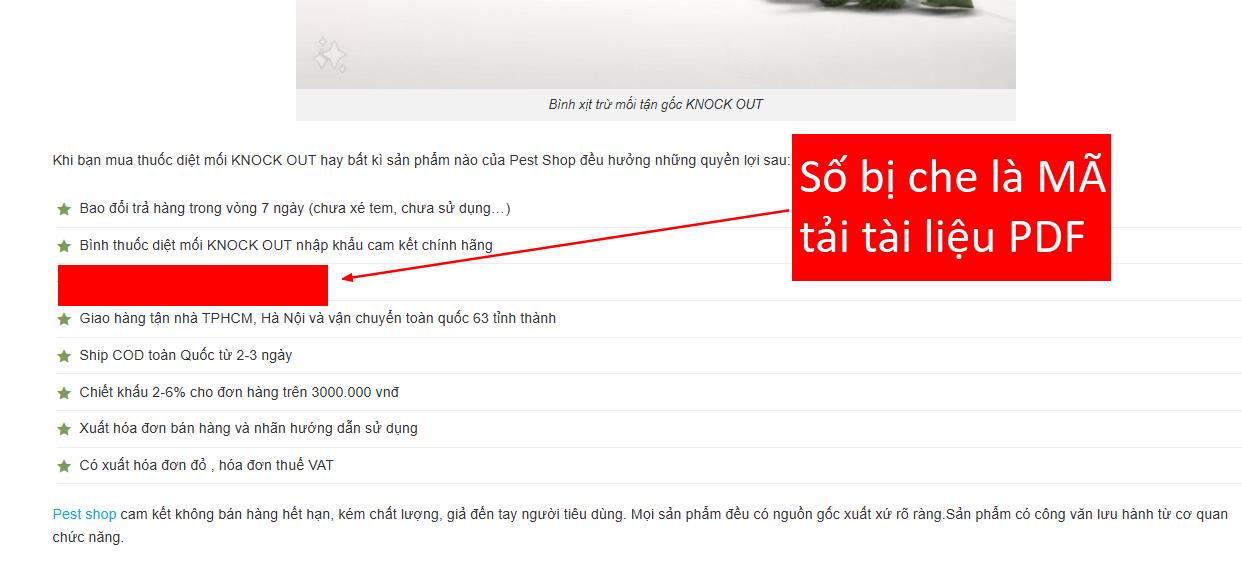
IELTS WRITING TASK 1 + 2
THE ULTIMATE GUIDE WITH PRACTICE TO GET A TARGET BAND SCORE OF 8.0+ IN 10 MINUTES A DAY
[Hình ảnh minh họa: Biểu đồ tròn, biểu đồ cột, biểu đồ đường]
[Hình ảnh: Một tờ giấy có ghi điểm A+ và chữ “excellent!”]
RACHEL MITCHELL
HÌNH 2
INTRODUCTION
Thank you and congratulate you for downloading the book “IELTS Academic Writing Task 1 + 2: The Ultimate Guide with Practice to Get a Target Band Score of 8.0+ In 10 Minutes a Day.”
This book is well designed and written by an experienced native teacher from the USA who has been teaching IELTS for over 10 years. She really is the expert in training IELTS for students at each level. In this book, she will provide you all proven formulas, tips, strategies, explanations, structures, task 1 + Task 2 language, vocabulary, reports and model essays to help you easily achieve an 8.0+ in the IELTS Writing section, even if your English is not excellent. This book will also walk you through step-by-step on how to develop your well-organised answers for the Task 1 + Task 2 Writing; clearly explains the different types of questions that are asked for Task 1 + Task 2; provide you step-by-step instructions on how to write each type of report and essay excellently.
As the author of this book, Rachel Mitchell believes that this book will be an indispensable reference and trusted guide for you who may want to maximize your band score in IELTS Academic Task 1 + Task 2 Writing. Once you read this book, I guarantee you that you will have learned an extraordinarily wide range of useful, and practical IELTS WRITING strategies and formulas that will help you become a successful IELTS taker as well as you will even become a successful English user in work and in life within a short period of time only.
Take action today and start getting better scores tomorrow!
Thank you again for purchasing this book, and I hope you enjoy it.
HÌNH 3
IELTS WRITING INTRODUCTION
The IELTS Academic Writing lasts for 60 minutes (an hour). In the 1 hour, you have to complete 2 tasks, task 1 is a report, and task 2 is an essay. It is suggested that you should spend about 20 minutes on task 1 and about 40 minutes on task 2. In the IELTS Academic Writing task 1, you are required to write at least 150 words (10 to 15 sentences) and 220 words maximum. On the other hand, in the IELTS Academic Writing task 2, you are required to write at least 250 words (20 to 25 sentences) and 300 words maximum. Writing task 1 accounts for 1/3 while writing task 2 accounts for 2/3 of your total writing score.
In the IELTS Writing test, you need to use academic language. It’s not informal language (it’s not an email to your friend). We need to use academic language.
HÌNH 4
IELTS WRITING TASK 1
What are they asking you to do in a report?
They’re asking you to describe the main points of the diagram. When I say “describe”, I mean you will tell them what the diagram looks like? For example, I have a diagram that shows fast food consumption, I simply need to describe that fast food consumption has increased/ has grown/ has risen; I don’t need to say “fast food consumption has risen because fast food is delicious and affordable” No, you don’t need to explain, ok?. Explaining is what you are going to do essays in task 2 writing. Therefore, in task 1 writing, your job is to describe the main points of a diagram.
What is a diagram? You might be asking. That’s a good question. These are all examples of diagrams.
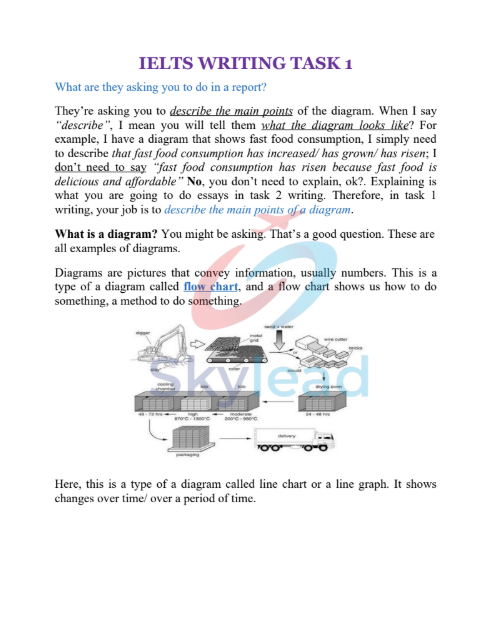
Diagrams are pictures that convey information, usually numbers. This is a type of a diagram called flow chart, and a flow chart shows us how to do something, a method to do something.
[Hình ảnh minh họa: Sơ đồ quy trình sản xuất gạch (flow chart)]
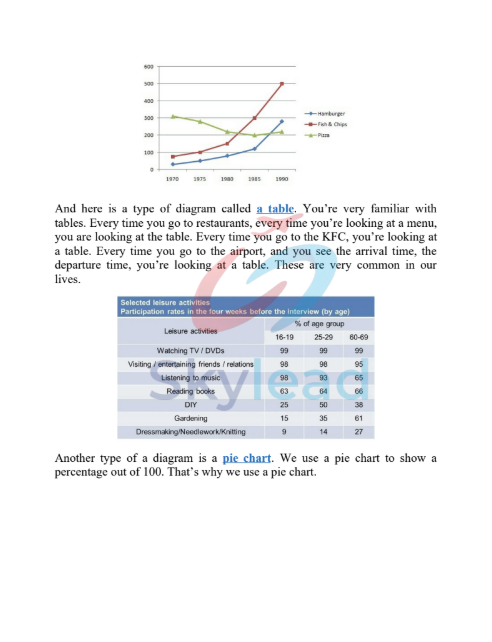
Here, this is a type of a diagram called line chart or a line graph. It shows changes over time/ over a period of time.
HÌNH 5
[Hình ảnh minh họa: Biểu đồ đường (line graph) về tiêu thụ Hamburger, Fish & Chips, Pizza]
And here is a type of diagram called a table. You’re very familiar with tables. Every time you go to restaurants, every time you’re looking at a menu, you are looking at the table. Every time you go to the KFC, you’re looking at a table. Every time you go to the airport, and you see the arrival time, the departure time, you’re looking at a table. These are very common in our lives.
[Hình ảnh minh họa: Bảng số liệu “Selected leisure activities Participation rates…”]
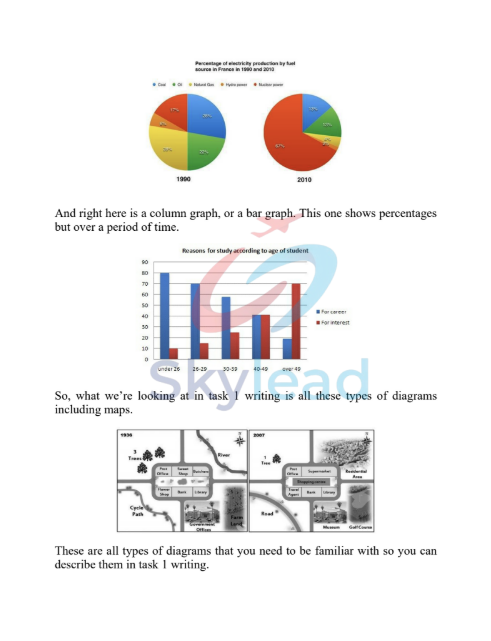
Another type of a diagram is a pie chart. We use a pie chart to show a percentage out of 100. That’s why we use a pie chart.
HÌNH 6
[Hình ảnh minh họa: Hai biểu đồ tròn về sản xuất điện tại Pháp năm 1990 và 2010]
And right here is a column graph, or a bar graph. This one shows percentages but over a period of time.
[Hình ảnh minh họa: Biểu đồ cột (bar graph) “Reasons for study according to age of student”]
So, what we’re looking at in task 1 writing is all these types of diagrams including maps.
[Hình ảnh minh họa: Hai bản đồ so sánh khu vực năm 1936 và 2007]
These are all types of diagrams that you need to be familiar with so you can describe them in task 1 writing.
HÌNH 7
All right, when it comes to task 1 writing, there are a few rules you need to pay your attention to. First of all, task 1 requires 150 words minimum. If you write fewer than 150 words, you’re going to face a penalty. Therefore, you should try to write at least 150 words. I will tell you that it will be difficult for you to get a high score if you’re only writing 150 words. You probably will need to write 200 or 210 words to get a high score (7.5 – 8.0).
For task 2 writing, it’s larger. It needs 250 words minimum, and the essay is worth 2/3 of your score. It’s worth twice of task 1. Therefore, I would like to tell you that you should write task 2 first and spend 40 minutes on it.
Now, we will focus on task 1 writing, we will be describing different kinds of diagrams.
How are they marking you? How are they assessing you? How are they giving you a score in task 1 writing?
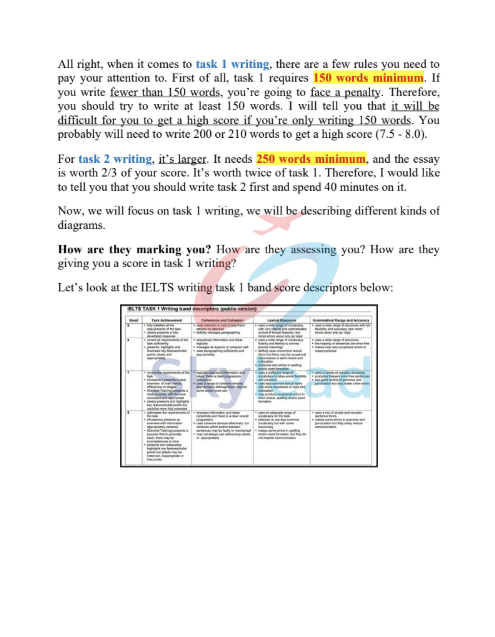
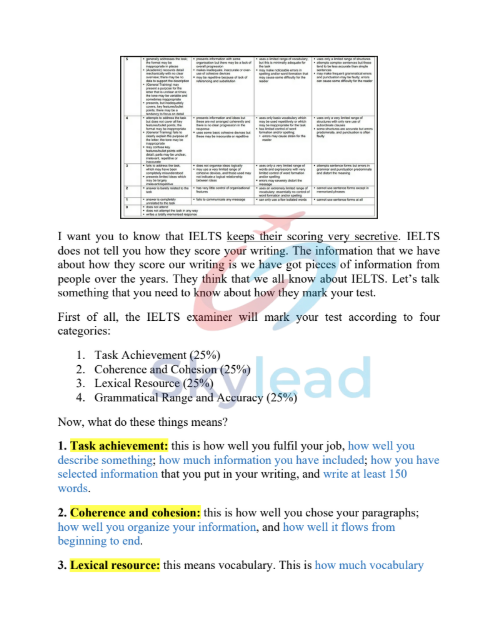
Let’s look at the IELTS writing task 1 band score descriptors below:
[Hình ảnh: Một phần của bảng “IELTS TASK 1 Writing band descriptors (public version)” cho các mức Band 9, 8, 7, 6]
HÌNH 8
[Hình ảnh: Tiếp nối bảng “IELTS TASK 1 Writing band descriptors” cho các mức Band 5, 4, 3, 2, 1, 0]
I want you to know that IELTS keeps their scoring very secretive. IELTS does not tell you how they score your writing. The information that we have about how they score our writing is we have got pieces of information from people over the years. They think that we all know about IELTS. Let’s talk something that you need to know about how they mark your test.
First of all, the IELTS examiner will mark your test according to four categories:
- Task Achievement (25%)
- Coherence and Cohesion (25%)
- Lexical Resource (25%)
- Grammatical Range and Accuracy (25%)
Now, what do these things mean?
1. Task achievement: this is how well you fulfil your job, how well you describe something; how much information you have included; how you have selected information that you put in your writing, and write at least 150 words.
2. Coherence and cohesion: this is how well you chose your paragraphs; how well you organize your information, and how well it flows from beginning to end.
3. Lexical resource: this means vocabulary. This is how much vocabulary
HÌNH 9
you use, and how varied, accurate and appropriate you are with your vocabulary. Spelling errors will hurt your score, misusing word forms will hurt your score. If you say “sales increasing”, it’s wrong. Instead, you must say “sales increased”
4. Grammatical range and accuracy: obviously this means “are you making grammar mistakes?”, and “are you using complex sentence structures?” if you’re just doing the same structure over and over, “sales increased”, then “sales fluctuated” and then “sales plummeted”. Ok, your grammar is accurate, but all you’re giving me is just past tense, past tense, and past tense. So you will get a good score for being accurate, but you will get a low score for using the same structure over and over.
What you should be doing in task 1 is you should practice regularly. 7.0 – 8.0 for task 1 writing is very achievable because the language you use for task 1 writing is very narrow, and very limited. You don’t need to use a huge range of language.
IELTS is a game after all. It is a test does exactly a game. It is a system for gaining points and losing points, and there are some rules to test. Therefore, we need to be sure we understand the rules so that we can avoid the penalty.
In order for us to describe diagrams, I would say grammar helps. Yes, of course it does. I need you to pay attention to grammar, sentence structures.
You could get an incredibly high score just by knowing these following structures.