

[Hình 1]
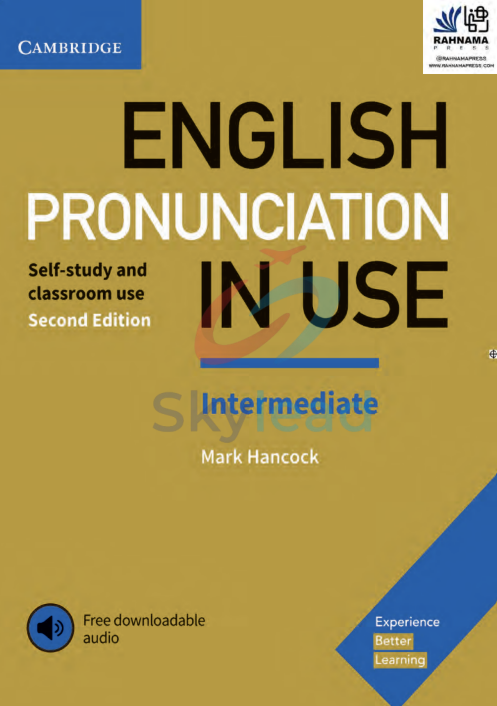
CAMBRIDGE
ENGLISH PRONUNCIATION IN USE
Self-study and classroom use
Second Edition
Intermediate
Mark Hancock
Free downloadable audio
Experience Better Learning
RAHNAMA PRESS @RAHNAMAPRESS WWW.RAHNAMAPRESS.COM
[Hình 2]
Contents
Acknowledgements 5
To the student 6
To the teacher 8
Section A sounds
Letters and sounds
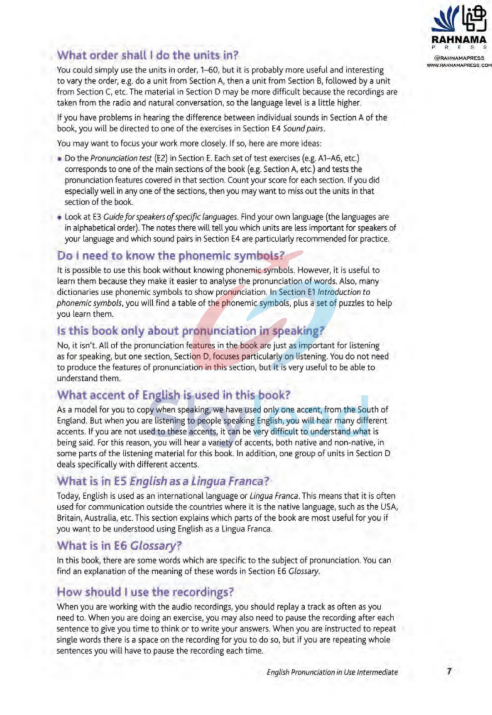
1 From zero to hero | Playing with the sounds of English 10
2 Plane, plan | The vowel sounds /ei/ and /æ/ 12
3 Back, pack | The consonant sounds /b/ and /p/ 14
4 Rice, rise | The consonant sounds /s/ and /z/ 16
5 Down town | The consonant sounds /d/ and /t/ 18
6 Meet, met | The vowel sounds /i:/ and /e/ 20
7 Carrot, cabbage | Unstressed vowels /ə/ and /i/ 22
8 Few, view | The consonant sounds /f/ and /v/ 24
9 Gate, Kate | The consonant sounds /g/ and /k/ 26
10 He, we, you | The sounds /h/, /w/ and /j/ 28
11 Kite, kit | The vowel sounds /ai/ and /i/ 30
12 Sheep, jeep, cheap | The consonant sounds /∫/, /dʒ/ and /t∫/ 32
13 Lent, rent | The consonant sounds /l/ and /r/ 34
14 Car, care | The vowel sounds /a:(r)/ and /eə(r)/ 36
15 Some, sun, sung | The consonant sounds /m/, /n/ and /ŋ/ 38
16 Note, not | The vowel sounds /əʊ/ and /ɒ/ 40
17 Thick, they | The consonant sounds /θ/ and /ð/ 42
18 Shut, pull, rude | The vowel sounds /ʌ/, /ʊ/ and /u:/ 44
19 Shirts, shorts | The vowel sounds /ɜ:(r)/ and /ɔ:(r)/ 46
20 Toy, town | The vowel sounds /ɔi/ and /aʊ/ 48
Combining sounds
21 Dream, cream, scream | Consonant groups at the beginning of words 50
22 Left, lunch, last | Consonant groups at the end of words 52
23 Wins, weeks, wages | Words with -s endings 54
24 Rested, played, watched | Words with -ed endings 56
25 Pets enter, pet centre | Consonant sounds at word boundaries 58
26 War and peace | Vowel sounds at word boundaries 60
Section B Stress
Word Stress
27 Saturday September 13th | Introducing word stress 62
28 Forest, forget | Stress in two-syllable words 64
29 Second-hand bookshop | Stress in compound words 66
30 Unforgettable | Stress in longer words 1 68
31 Public, publicity | Stress in longer words 2 70
Stress patterns
32 Tea for two | Introducing stress patterns 72
33 He asked her her name | Pronouns in stress patterns 74
34 The place is clean | The verb to be in stress patterns 76
35 What do you think? | Auxiliary verbs in stress patterns 78
36 Some milk and eggs | Pronouncing short words (a, of, or) 80
English Pronunciation in Use Intermediate 3
[Hình 3]
Section C Intonation
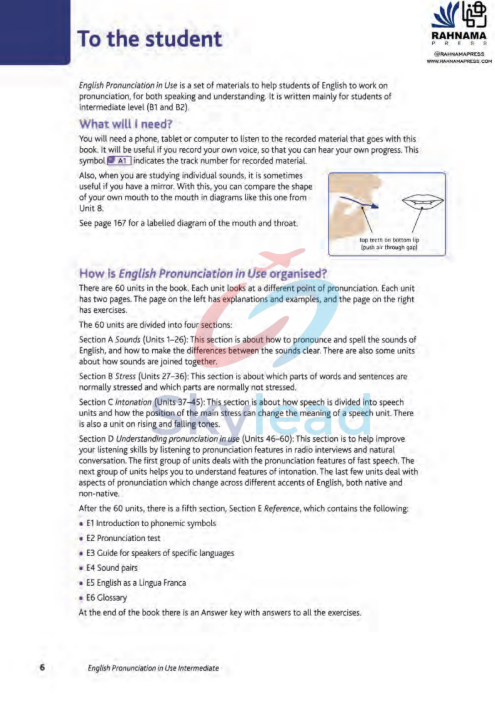
37 // CHILDREN // DRIVE SLOWLY // | Dividing messages into speech units 82
38 // His sister // who was clever // won | Speech units and grammar 84
39 // Sorry to disturb you // | Introduction to main stress 86
40 // He will win // | Emphasising a contrasting opinion 88
41 // Schwartz // Pedro Schwartz // | Emphasising added details 90
42 // What do you do? // | Main stress in questions 92
43 // I think you’re in my seat // | Main stress for contrasting information 94
44 // Fifty? // No // fifteen! // | Emphasising corrections 96
45 Bear! ↘ Bear? ↗ | Rising and falling tones 98
Section D Understanding pronunciation in use
Speed
46 // Ehm… // Well… // | Thinking time 100
47 // I mean // and just kind of // | Unstressed words in conversation 102
48 Scuba_diving_course | Listening to connected speech 104
49 White_bread or brown_bread? | Connected speech: sound changes 106
50 // Do you actually know // | Fast and careful speech 108
Tone
51 // The kitchen ↗ // the garden ↗ // and the grounds // | Continuing or finishing tones 110
52 // It’s about four hours ↗ // | Sure and unsure tones 112
53 // Do I press ‘enter’? ↗ // | Intonation in instructions 114
54 // He’s quite rude ↘ // isn’t he? ↘ // | Intonation in opinions 116
55 // It’s absolutely stunning ↘ // | Showing enthusiasm 118
Accents
56 Finders keepers | Accent variation relating to R 120
57 We had a cat | Vowel sound variation in different accents 122
58 Rita’s writing a book | Consonant sound variation in different accents 124
59 Hello. I’m from… | English from around the world 126
60 Fairtrade | Pronunciation objectives: clarity or speed? 128
Section E Reference
E1 Introduction to phonemic symbols 130
E2 Pronunciation test 137
E3 Guide for speakers of specific languages 143
E4 Sound pairs 146
E5 English as a Lingua Franca 163
E6 Glossary 166
Answer key 168
4 English Pronunciation in Use Intermediate
[Hình 4]
To the student
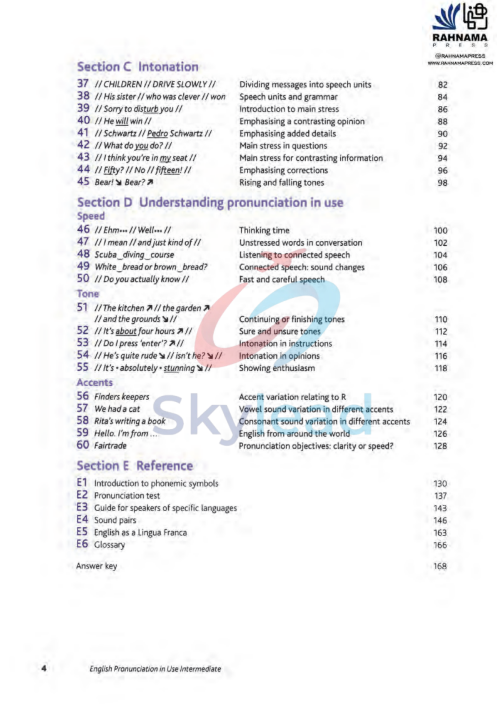
English Pronunciation in Use is a set of materials to help students of English to work on pronunciation, for both speaking and understanding. It is written mainly for students of intermediate level (B1 and B2).
What will I need?
You will need a phone, tablet or computer to listen to the recorded material that goes with this book. It will be useful if you record your own voice, so that you can hear your own progress. This symbol A1 indicates the track number for recorded material.
Also, when you are studying individual sounds, it is sometimes useful if you have a mirror. With this, you can compare the shape of your own mouth to the mouth in diagrams like this one from Unit 8.
See page 167 for a labelled diagram of the mouth and throat.
[Hình minh họa vị trí môi: top teeth on bottom lip / push air through gap]
How is English Pronunciation in Use organised?
There are 60 units in the book. Each unit looks at a different point of pronunciation. Each unit has two pages. The page on the left has explanations and examples, and the page on the right has exercises.
The 60 units are divided into four sections:
Section A Sounds (Units 1-26): This section is about how to pronounce and spell the sounds of English, and how to make the differences between the sounds clear. There are also some units about how sounds are joined together.
Section B Stress (Units 27-36): This section is about which parts of words and sentences are normally stressed and which parts are normally not stressed.
Section C Intonation (Units 37-45): This section is about how speech is divided into speech units and how the position of the main stress can change the meaning of a speech unit. There is also a unit on rising and falling tones.
Section D Understanding pronunciation in use (Units 46-60): This section is to help improve your listening skills by listening to pronunciation features in radio interviews and natural conversation. The first group of units deals with the pronunciation features of fast speech. The next group of units helps you to understand features of intonation. The last few units deal with aspects of pronunciation which change across different accents of English, both native and non-native.
After the 60 units, there is a fifth section, Section E Reference, which contains the following:
• E1 Introduction to phonemic symbols
• E2 Pronunciation test
• E3 Guide for speakers of specific languages
• E4 Sound pairs
• E5 English as a Lingua Franca
• E6 Glossary
At the end of the book there is an Answer key with answers to all the exercises.
6 English Pronunciation in Use Intermediate
[Hình 5]
What order shall I do the units in?
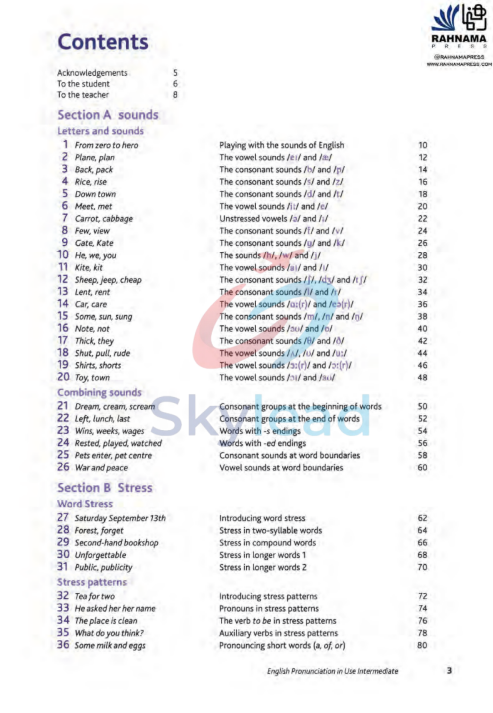
You could simply use the units in order, 1-60, but it is probably more useful and interesting to vary the order, e.g. do a unit from Section A, then a unit from Section B, followed by a unit from Section C, etc. The material in Section D may be more difficult because the recordings are taken from the radio and natural conversation, so the language level is a little higher.
If you have problems in hearing the difference between individual sounds in Section A of the book, you will be directed to one of the exercises in Section E4 Sound pairs.
You may want to focus your work more closely. If so, here are more ideas:
• Do the Pronunciation test (E2) in Section E. Each set of test exercises (e.g. A1-A6, etc.) corresponds to one of the main sections of the book (e.g. Section A, etc.) and tests the pronunciation features covered in that section. Count your score for each section. If you did especially well in any one of the sections, then you may want to miss out the units in that section of the book.
• Look at E3 Guide for speakers of specific languages. Find your own language (the languages are in alphabetical order). The notes there will tell you which units are less important for speakers of your language and which sound pairs in Section E4 are particularly recommended for practice.
Do i need to know the phonemic symbols?
It is possible to use this book without knowing phonemic symbols. However, it is useful to learn them because they make it easier to analyse the pronunciation of words. Also, many dictionaries use phonemic symbols to show pronunciation. In Section E1 Introduction to phonemic symbols, you will find a table of the phonemic symbols, plus a set of puzzles to help you learn them.
Is this book only about pronunciation in speaking?
No, it isn’t. All of the pronunciation features in the book are just as important for listening as for speaking, but one section, Section D, focuses particularly on listening. You do not need to produce the features of pronunciation in this section, but it is very useful to be able to understand them.
What accent of English is used in this book?
As a model for you to copy when speaking, we have used only one accent, from the South of England. But when you are listening to people speaking English, you will hear many different accents. If you are not used to these accents, it can be very difficult to understand what is being said. For this reason, you will hear a variety of accents, both native and non-native, in some parts of the listening material for this book. In addition, one group of units in Section D deals specifically with different accents.
What is in E5 English as a Lingua Franca?
Today, English is used as an international language or Lingua Franca. This means that it is often used for communication outside the countries where it is the native language, such as the USA, Britain, Australia, etc. This section explains which parts of the book are most useful for you if you want to be understood using English as a Lingua Franca.
What is in E6 Glossary?
In this book, there are some words which are specific to the subject of pronunciation. You can find an explanation of the meaning of these words in Section E6 Glossary.
How should I use the recordings?
When you are working with the audio recordings, you should replay a track as often as you need to. When you are doing an exercise, you may also need to pause the recording after each sentence to give you time to think or to write your answers. When you are instructed to repeat single words there is a space on the recording for you to do so, but if you are repeating whole sentences you will have to pause the recording each time.
English Pronunciation in Use Intermediate 7