Tải FREE sách Prism Reading 4 PDF - Student's Book

Tải FREE sách Prism Reading 4 PDF – Student’s Book

Tải FREE sách Prism Reading 4 PDF – Student’s Book là một trong những đáng đọc và tham khảo. Hiện Tải FREE sách Prism Reading 4 PDF – Student’s Book đang được SkyLead chia sẻ miễn phí dưới dạng file PDF.

=> Nhấn nút Tải PDF ngay ở bên dưới để tải Tải FREE sách Prism Reading 4 PDF – Student’s Book về máy của bạn nhé!

Mô tả sách / Tài liệu

Để giúp bạn có cái nhìn sơ lược và làm quen trước với nội dung, đội ngũ biên tập của chúng tôi đã trích dẫn một phần nhỏ từ cuốn sách ngay bên dưới. Nếu bạn muốn đọc toàn bộ tác phẩm này, hãy nhấp vào nút “Tải PDF ngay” ở phía trên để tải về bản tiếng Việt đầy đủ hoàn toàn miễn phí nhé!

PHÂN TÍCH CHUYÊN SÂU GIÁO TRÌNH PRISM READING 4

Giáo trình Prism Reading 4 được tổ chức thành mười hai đơn vị học tập chính (Units 1-12), mỗi đơn vị tập trung vào một chủ đề học thuật liên ngành rộng lớn, đảm bảo sự tiếp xúc của học viên với đa dạng các lĩnh vực kiến thức. Mỗi đơn vị được cấu trúc một cách logic để phát triển toàn diện từ kỹ năng đọc hiểu cơ bản đến kỹ năng tư duy phản biện cấp cao.

1. Cấu trúc Tổng thể của Đơn vị Bài học (Unit Structure)

Mỗi đơn vị được xây dựng dựa trên hai bài đọc chính (Reading 1Reading 2) xoay quanh cùng một chủ đề, nhưng thường trình bày các góc nhìn hoặc khía cạnh khác nhau của vấn đề. Cấu trúc điển hình của mỗi đơn vị bao gồm:

1.1. Khởi động và Thiết lập Bối cảnh (Getting Started and Context)

  • Unit Question: Giới thiệu một câu hỏi lớn, mở, mang tính thảo luận, định hướng toàn bộ nội dung của đơn vị. Ví dụ: “What is the value of failure?” (Giá trị của thất bại là gì?)
  • Discussing the Topic: Hoạt động thảo luận nhóm hoặc cá nhân để kích hoạt kiến thức nền (schema) của học viên về chủ đề.
  • Before You Read: Cung cấp từ vựng học thuật trọng tâm (Target Vocabulary) liên quan đến chủ đề và bài đọc sắp tới, giúp học viên chuẩn bị trước về ngôn ngữ.

1.2. Phát triển Kỹ năng Đọc 1 (Reading 1 Focus)

  • Reading Passage 1: Thường là một văn bản học thuật hoặc báo chí dài, có độ khó cao, liên quan trực tiếp đến Unit Question.
  • Reading Skill Focus: Tập trung vào một kỹ năng đọc hiểu cơ bản, ví dụ: Scanning for specific details, Skimming for the main idea, Identifying the writer’s purpose.
  • Comprehension Checks: Các bài tập kiểm tra mức độ hiểu chi tiết và tổng thể của bài đọc.

1.3. Phát triển Kỹ năng Tư duy Phản biện (Critical Thinking Focus)

  • Đây là phần cốt lõi của giáo trình Prism, chuyển người học từ việc hiểu thông tin sang việc đánh giáphân tích thông tin.
  • Skill Focus: Tập trung vào các kỹ năng cấp cao như: Evaluating supporting evidence, Distinguishing facts from opinions, Identifying bias, Analyzing cause and effect, Synthesizing information from multiple sources.
  • Applying the Skill: Áp dụng kỹ năng tư duy phản biện vừa học để phân tích sâu hơn bài đọc Một hoặc các tình huống liên quan.

1.4. Phát triển Kỹ năng Đọc 2 và Tổng hợp (Reading 2 and Synthesis)

  • Reading Passage 2: Văn bản thứ hai thường thách thức hơn, có thể là một đoạn trích từ sách giáo khoa, nghiên cứu, hoặc bài luận, cung cấp một góc nhìn khác về chủ đề chính.
  • Reading Skill Review: Ôn tập và củng cố các kỹ năng đọc đã học.
  • Critical Thinking Follow-up: Học viên được yêu cầu tổng hợp thông tin từ hai bài đọc, so sánh các quan điểm, và đưa ra ý kiến cá nhân có căn cứ.

1.5. Củng cố Từ vựng và Viết (Vocabulary and Writing)

  • Vocabulary Practice: Thực hành sử dụng từ vựng học thuật trọng tâm đã được giới thiệu (thường là sáu đến tám từ mới mỗi đơn vị) trong các bối cảnh khác nhau.
  • Writing Task: Nhiệm vụ viết ngắn, yêu cầu học viên áp dụng kiến thức và từ vựng từ đơn vị để viết một đoạn văn hoặc một bài phản hồi ngắn, thường liên quan đến việc tổng hợp thông tin và bày tỏ quan điểm.

2. Phân tích Trọng tâm Kỹ năng Đọc và Từ vựng Học thuật

Cấp độ Bốn của Prism Reading không chỉ dừng lại ở việc dạy đọc mà còn tích cực trang bị cho người học bộ công cụ ngôn ngữ và chiến lược cần thiết cho môi trường đại học.

2.1. Chiến lược Đọc Hiểu Chuyên sâu

  • Inference and Implication: Kỹ năng suy luận, đọc giữa các dòng, hiểu ý nghĩa ngụ ý mà tác giả không nói rõ (rất quan trọng trong các bài thi như IELTS hoặc TOEFL).
  • Text Structure Analysis: Phân tích cấu trúc tổ chức của văn bản học thuật (ví dụ: Problem-Solution, Comparison-Contrast, Classification). Việc này giúp người đọc dự đoán và theo dõi luồng thông tin.
  • Identifying Thesis and Main Ideas: Luyện tập tìm ra luận điểm chính (Thesis Statement) trong các văn bản dài và phức tạp, nơi ý chính có thể không được đặt ở vị trí đầu tiên hoặc cuối cùng của đoạn.

2.2. Phát triển Từ vựng Học thuật (Academic Vocabulary)

Giáo trình này tập trung vào các từ vựng cốt lõiWord Families (gia đình từ) cần thiết cho văn bản học thuật:

  • Collocations: Dạy các từ đi kèm tự nhiên với nhau (ví dụ: gain insight, draw a conclusion, pose a threat).
  • Academic Word List (AWL): Phần lớn từ vựng trọng tâm trong giáo trình được chọn lọc từ danh sách các từ học thuật phổ biến nhất, đảm bảo tính ứng dụng cao.
  • Word Parts: Phân tích các gốc từ, tiền tố, và hậu tố để giúp người học suy đoán nghĩa của từ mới mà không cần tra từ điển. Ví dụ: tiền tố co- (cùng), hậu tố -ity (tính chất).

3. Trọng tâm Tư duy Phản biện và Tổng hợp Thông tin

Mục tiêu lớn nhất của Prism Reading 4 là nâng cao năng lực tư duy phản biện, một kỹ năng không thể thiếu trong giáo dục đại học quốc tế.

3.1. Các Kỹ năng Tư duy Phản biện Cao Cấp

  • Recognizing Rhetorical Purpose: Nhận diện mục đích hùng biện của tác giả (ví dụ: mục đích là thuyết phục, thông báo, giải trí hay chỉ trích?).
  • Evaluating Credibility: Đánh giá độ tin cậy của nguồn thông tin, phân biệt giữa nghiên cứu khoa học, ý kiến cá nhân, và bằng chứng giai thoại.
  • Identifying Assumptions: Nhận ra những giả định ngầm của tác giả trong quá trình lập luận.
  • Challenging the Text: Khuyến khích học viên không chấp nhận thông tin một cách thụ động, mà đặt câu hỏi và tìm kiếm các quan điểm đối lập.

3.2. Tổng hợp và Đánh giá Đa Quan điểm

  • Synonyms and Paraphrasing: Luyện tập viết lại ý của người khác bằng từ ngữ của mình (paraphrasing) để tránh đạo văn và củng cố sự hiểu biết.
  • Synthesizing Information: Sau khi đọc hai bài đọc với các quan điểm khác nhau (ví dụ: bài 1 ủng hộ công nghệ, bài 2 cảnh báo về tác hại), học viên phải tổng hợp các ý chính từ cả hai nguồn để hình thành một phản hồi có căn cứ.
  • Formulating an Argument: Hướng dẫn cách xây dựng luận điểm của bản thân, sử dụng bằng chứng từ các bài đọc để hỗ trợ hoặc phản bác các lập luận đó.

4. Phân tích Nội dung Chủ đề (Thematic Content Analysis)

Mỗi đơn vị khám phá một lĩnh vực học thuật cụ thể, từ khoa học tự nhiên, xã hội học, đến kinh tế và môi thưường. Một vài ví dụ về chủ đề:

  • Đơn vị 1: The Future of Work (Tương lai của công việc) – Thảo luận về tự động hóa, AI, và vai trò của con người.
  • Đơn vị 5: The Ethics of Science (Đạo đức trong khoa học) – Phân tích các vấn đề đạo đức trong di truyền học và nghiên cứu y sinh.
  • Đơn vị 8: The Psychology of Happiness (Tâm lý học về Hạnh phúc) – Khám phá các nghiên cứu về hạnh phúc, từ tiền bạc đến các mối quan hệ xã hội.
  • Đơn vị 11: Global Challenges (Thách thức toàn cầu) – Đề cập đến biến đổi khí hậu, nước sạch, và năng lượng tái tạo.

Việc đa dạng hóa chủ đề giúp người học làm quen với nhiều phong cách viết và từ vựng chuyên ngành khác nhau, một sự chuẩn bị lý tưởng cho bất kỳ ngành học nào ở bậc đại học.


5. Kết luận về Giá trị Sư phạm

Giáo trình Prism Reading 4 là một tài liệu học tập có giá trị đặc biệt, vượt qua vai trò của một sách luyện kỹ năng đọc thông thường.

  • Tăng cường Khả năng Đọc Học thuật: Nó cung cấp một lộ trình có hệ thống để tiếp thu và xử lý các văn bản học thuật phức tạp ở trình độ B hai (B2) trở lên.
  • Phát triển Tư duy Phản biện: Việc nhấn mạnh vào kỹ năng phân tích, tổng hợp và đánh giá thông tin là điểm khác biệt chính, giúp người học chuyển từ vai trò là người tiêu thụ thông tin thành người tạo ra kiến thức.
  • Chuẩn bị cho Môi trường Đại học: Giáo trình rèn luyện các kỹ năng cần thiết cho việc học tập ở bậc cao hơn, bao gồm khả năng đọc hai văn bản về cùng một chủ đề để viết một bài phản hồi tổng hợp, một nhiệm vụ phổ biến trong các khóa học đại học.
  • Củng cố Từ vựng: Thông qua việc tập trung vào Academic Word ListWord Families, người học tích lũy được vốn từ vựng học thuật vững chắc, cần thiết cho mọi kỹ năng ngôn ngữ khác (Nghe, Nói, Viết).

Tóm lại, Prism Reading 4 là một khóa học toàn diện, tập trung vào việc tạo ra những người đọc không chỉ hiểu mà còn có khả năng tư duy sâu sắcđánh giá phê phán về thông tin họ tiếp nhận.

Tải FREE sách Prism Reading 4 PDF – Student’s Book


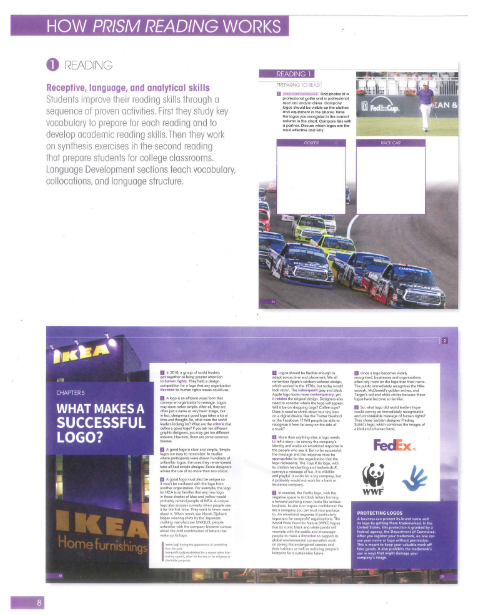
TRANG 1: HOW PRISM READING WORKS (Trang 8)

Tiêu đề chính: HOW PRISM READING WORKS

Phần 1 READING
Receptive, language, and analytical skills
Students improve their reading skills through a sequence of proven activities. First they study key vocabulary to prepare for each reading and to develop academic reading skills. Then they work on synthesis exercises in the second reading that prepare students for college classrooms. Language Development sections teach vocabulary, collocations, and language structure.

Khung READING 1 – PREPARING TO READ

  • ACTIVATING YOUR KNOWLEDGE: Find photos of a professional golfer and a professional race car and/or driver. Company logos should be visible on the clothes and equipment in the photos. Name the logos you recognize in the correct column in the chart. Compare lists with a partner. Discuss which logos are the most effective and why.
  • Bảng:
    • GOLFER
    • RACE CAR
  • Hình ảnh ví dụ: FedEx Cup, PEAN &, xe đua số 15.

Nội dung bài đọc CHAPTER 5: WHAT MAKES A SUCCESSFUL LOGO?

  • Tiêu đề: WHAT MAKES A SUCCESSFUL LOGO?
  • IKEA Home furnishings
  • Đoạn 1: In 2010, a group of world leaders got together to bring greater attention to human rights. They held a design competition for a logo that any organization devoted to human rights issues could use.
  • Đoạn 2: A logo is an efficient visual form that conveys an organization’s message. Logos may even seem rather simple. After all, they are often just a name or very basic image, but in fact, designing a good logo takes a lot of time and thought. So, what were the world leaders looking for? What are the criteria that define a good logo? If you ask ten different graphic designers, you may get ten different answers. However, there are some common themes.
  • Đoạn 3: A good logo is clear and simple. Simple logos are easy to remember. In studies where participants were shown hundreds of unfamiliar logos, the ones they remembered later all had simple designs. Some designers advise the use of no more than two colors.
  • Đoạn 4: A good logo must also be unique so it won’t be confused with the logo from another organization. For example, the logo for IKEA is so familiar that any new logo in those shades of blue and yellow would probably remind people of IKEA. A unique logo also arouses curiosity when people see it for the first time. They want to know more about it. When sports star Hitoshi Ohkoshi began wearing shirts by the Japanese clothing manufacturer UNIQLO, people unfamiliar with the company became curious about the odd combination of letters that make up its logo.
  • Đoạn 5: Logos should be flexible enough to adapt across time and placement. We all remember Apple’s rainbow colored design, which worked in the 1970s, but today would look retro. The subsequent gray and black Apple logo looks more contemporary, yet it retains the original design. Designers also need to consider where the logo will appear. Will it be on shopping bags? Coffee cups? Does it need to shrink down to a tiny icon on a digital device like the Thorne (twitter) or the Facebook ‘f’? Will people be able to recognize it from far away on the side of a truck?
  • Đoạn 6: More than anything else, a logo needs to tell a story – to convey the company’s identity and evoke an emotional response in the people who see it. But to be successful, the message and the response must be appropriate for the organization that the logo represents. The Toys R Us logo, with its child-like handwriting and backward ‘R’, conveys a message of fun. It is childlike and playful. It works for a toy company, but it probably would not work for a bank or insurance company.
  • Đoạn 7: In contrast, the FedEx logo, with its negative space in its block letters forming a forward-pointing arrow, looks like serious business. Its aim is to inspire confidence that it is a company you can trust your package to. An emotional response is particularly important for nonprofit organizations. The World Wide Fund for Nature (WWF) hopes that its iconic black and white panda will resonate with the public and encourage people to make a donation to support its global environmental conservation work on saving the endangered species and their habitats as well as reducing people’s footprint for a sustainable future.
  • Đoạn 8: Once a logo becomes widely recognized, businesses and organizations often rely more on the logo than their name. The public immediately recognizes the Nike swoosh, McDonald’s golden arches, and Target’s red and white circles because these logos have become so familiar.
  • Đoạn kết: So, what logo did world leaders hope would convey an immediately recognizable and unmistakable message of human rights? They chose Serbian designer Predrag Stakić’s logo, which combines the images of a bird and a human hand.

Các khung phụ:

  • PROTECTING LOGOS: A business can protect its brand name and its logo by getting them trademarked. In the United States, this protection is granted by a federal agency, the Department of Commerce. After you register your trademark, no one can use your name or logo without permission. This is meant to keep your valuable mark off fake goods. It also prohibits the trademark’s use in ways that might damage your company’s image.
  • Từ vựng:
    • retro (adj): having the appearance of something from the past
    • nonprofit (adj): established for a reason other than making a profit, often for the arts or for religious or charitable purposes
  • Biểu tượng logo: FedEx, WWF, Logo nhân quyền.

Chân trang: 8


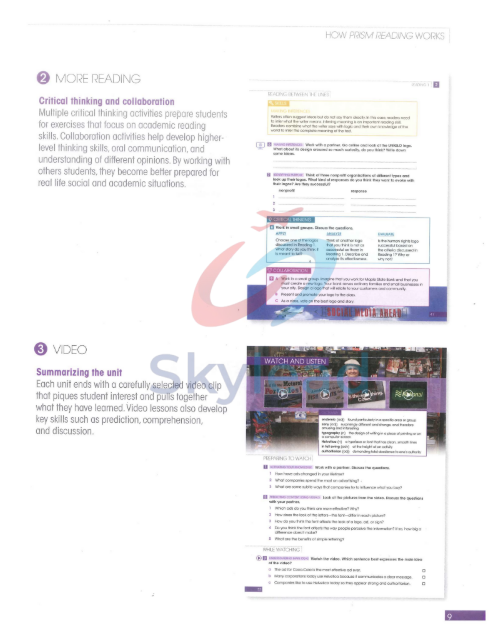
TRANG 2: MORE READING & VIDEO (Trang 9)

Tiêu đề phụ: HOW PRISM READING WORKS

Phần 2 MORE READING
Critical thinking and collaboration
Multiple critical thinking activities prepare students for exercises that focus on academic reading skills. Collaboration activities help develop higher-level thinking skills, oral communication, and understanding of different opinions. By working with others students, they become better prepared for real life social and academic situations.

Khung READING BETWEEN THE LINES

  • SKILLS – MAKING INFERENCES: Writers often suggest ideas but do not state them directly. In this case, readers need to infer what the writer means. Inferring meaning is an important reading skill. Readers combine what the writer says with logic and their own knowledge of the world to infer the complete meaning of the text.
  • A MAKING INFERENCES: Work with a partner. Go online and look at the UNIQLO logo. What about its design aroused so much curiosity, do you think? Write down some ideas.
  • B IDENTIFYING PURPOSE: Think of three nonprofit organizations of different types and look up their logos. What kind of response do you think they want to evoke with their logos? Are they successful?
  • Bảng: nonprofit / response (1, 2, 3)
  • CRITICAL THINKING – C Work in small groups. Discuss the questions:
    • APPLY: Choose one of the logos discussed in Reading 1. What story do you think it is meant to tell?
    • ANALYZE: Think of another logo that you think is not as successful as those in Reading 1. Describe and analyze its effectiveness.
    • EVALUATE: Is the human rights logo successful based on the criteria discussed in Reading 1? Why or why not?
  • COLLABORATION – D Work in small groups: Imagine that you work for Maple State Bank and that you must create a new logo. Your bank serves ordinary families and small businesses in your city. Design a logo that will relate to your customers and community.
    • A Present and promote your logo to the class.
    • B As a class, vote on the best logo and story.
  • Tiêu đề cuối hình: SOCIAL MEDIA AHEAD

Phần 3 VIDEO
Summarizing the unit
Each unit ends with a carefully selected video clip that piques student interest and pulls together what they have learned. Video lessons also develop key skills such as prediction, comprehension, and discussion.

Khung WATCH AND LISTEN

  • Từ vựng video:
    • ambient (adj): found particularly in a specific area or group
    • curious (adj): strange and therefore amusing and interesting
    • typography (n): the design of writing on a piece of printing or on a computer screen
    • typeface (n): a typeface or font that has clean, smooth lines
    • in full swing (adj): at the height of an activity
    • authoritarian (adj): demanding total obedience to one’s authority
  • PREPARING TO WATCH:
    • A ACTIVATING YOUR KNOWLEDGE: Work with a partner. Discuss the questions.
      1. How have ads changed in your lifetime?
      2. What companies spend the most on advertising?
      3. What are some subtle ways that companies try to influence what you buy?
    • B PREDICTING CONTENT USING VISUALS: Look at the pictures from the video. Discuss the questions with your partner.
      1. Which ads do you think are most effective? Why?
      2. How does the look of the letters — the font — differ in each picture?
      3. How do you think the font affects the look of a logo, ad, or sign?
      4. Do you think the font affects the way people perceive the information? If so, how big a difference does it make?
      5. What are the benefits of simple lettering?
  • WHILE WATCHING:
    • C UNDERSTANDING MAIN IDEAS: Watch the video. Which sentence best expresses the main idea of the video?
      • a The ad for Coca-Cola is the most effective ad ever.
      • b Many corporations today use Helvetica because it communicates a clear message.
      • c Companies like to use Helvetica today so they appear strong and authoritarian.

Chân trang: 9


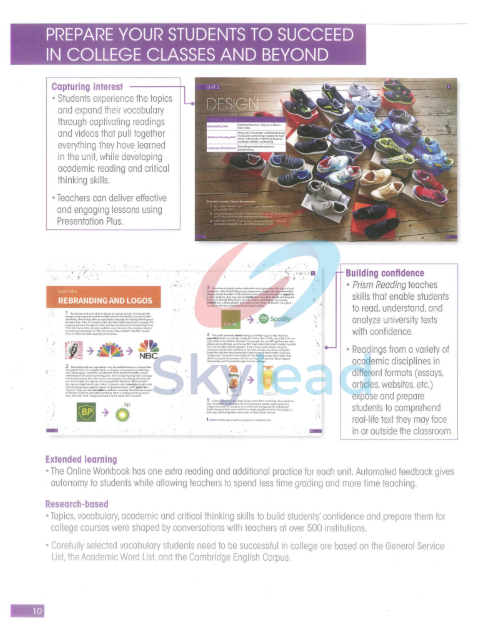
TRANG 3: PREPARE YOUR STUDENTS… (Trang 10)

Tiêu đề chính: PREPARE YOUR STUDENTS TO SUCCEED IN COLLEGE CLASSES AND BEYOND

Capturing interest

  • Students experience the topics and expand their vocabulary through captivating readings and videos that pull together everything they have learned in the unit, while developing academic reading and critical thinking skills.
  • Teachers can deliver effective and engaging lessons using Presentation Plus.

Khung UNIT 2 – DESIGN

  • Reading Skills: Identifying themes; using the editor to take notes
  • Additional Reading Skills: Previewing; identifying main ideas; identifying supporting details; scanning; taking notes; outlining; synthesizing
  • Language Development: Encoding; emotional; sentence processing
  • Câu hỏi thảo luận: Work with a partner. Discuss the questions.
    1. Who do you think chose the shoes in the photo? (The owner? The designer?)
    2. Why might an everyday object like a shoe be part of an art museum collection?
    3. What colors are common for shoes? Why might certain colors be more popular than others?

Khung CHAPTER 6 – REBRANDING AND LOGOS

  • Đoạn 1: Companies need to be able to adapt to style changes. To keep an old brand, they frequently update their logo and rebrand for a modern feel while at the same time. Take, for example, NBC (the National Broadcasting Company). This company started with a diagonal radio, then changed it to a colored peacock from 1956 till changed the bird for one newer peacock on its logo, adapted to 1956’s peacock brand. In 1996, for a third, NBC added NBC to the logo. (Kèm hình minh họa tiến hóa logo NBC).
  • Đoạn 2: Rebranding with new logo design also has useful business outcomes for nonprofit sites. For example, BP, a company that provides oil and gas services, turned to a solar symbol for its rebranding in 2000… (Kèm logo BP và Gap). Trong năm 2010, cửa hàng quần áo Gap đã thay đổi logo quen thuộc của mình… nhưng khách hàng không thích và họ đã quay lại logo cũ sau một tuần.
  • Đoạn 3: Some brands simply remove words and use a logo to identify. Many of today’s companies, Nike founded by young entrepreneur, Knight, and Apple founded by Steve Jobs. At first both Nike and Apple included their names. For today both Nike and Apple use only their logo to identify… (Kèm logo Spotify và Orange).
  • Đoạn 4: This could produce widely simple design to identify logos as they change… BP sun symbol replaced the older shield… (Kèm hình so sánh logo BP mới và cũ).
  • Đoạn 5: A few companies choose to keep their logo as they grow. For example, the clothing brand IKEA changed only its typeface in its rebranding… (Kèm logo IKEA).

Building confidence

  • Prism Reading teaches skills that enable students to read, understand, and analyze university texts with confidence.
  • Readings from a variety of academic disciplines in different formats (essays, articles, websites, etc.) expose and prepare students to comprehend real-life text they may face in or outside the classroom.

Extended learning

  • The Online Workbook has one extra reading and additional practice for each unit. Automated feedback gives autonomy to students while allowing teachers to spend less time grading and more time teaching.

Research-based

  • Topics, vocabulary, academic and critical thinking skills to build students’ confidence and prepare them for college courses were shaped by conversations with teachers at over 500 institutions.
  • Carefully selected vocabulary students need to be successful in college are based on the General Service List, the Academic Word List, and the Cambridge English Corpus.

Chân trang: 10